
A walk through the hidden history of Kelvingrove Park in Glasgow's West End

Stretching along the banks of the River Kelvin in Glasgow’s West End, Kelvingrove is a living monument to Victorian design and a part of Glasgow’s social history.
Created during the industrial growth of the nineteenth century, Kelvingrove became a statement of civic confidence with a carefully designed landscape intended to offer recreation and set the identity of a rapidly expanding city with global ambitions. Today, visitors wandering its winding paths encounter memorials, hidden relics, monumental staircases, echoes of empire, all set against the backdrop of one of Europe’s great civic museums.
Kelvingrove Park began life in the 1850s, when Glasgow Corporation purchased the Kelvingrove and Woodlands estates to create what was initially known as the West End Park. The city acquired more land in later decades, eventually shaping the 85-acre park visitors know today. The park was designed between 1852 and 1867 and is widely recognised as Scotland’s first purpose-built public park.
It emerged during an era when industrial cities across Britain were attempting to counter overcrowding, pollution and poor public health with ambitious civic spaces.Its layout was created by the celebrated landscape designer Sir Joseph Paxton, best known for London’s Crystal Palace and his work at Chatsworth House. Paxton used the River Kelvin as the park’s organising feature, designing sweeping curves and scenic viewpoints that still feature today.
Kelvingrove’s reputation expanded dramatically when it hosted a series of enormous international exhibitions in 1888, 1901 and 1911. These events transformed the park into a global showcase of science, industry, empire and culture.
The 1888 International Exhibition of Science and Art attracted almost six million visitors. Queen Victoria herself visited twice, and the exhibition cemented Glasgow’s status as one of the industrial capitals of the world. The even larger 1901 Glasgow International Exhibition drew more than eleven million visitors and left behind the park’s most famous building: Kelvingrove Art Gallery and Museum. The 1911 Scottish Exhibition featured elaborate attractions including a Highland Village, a “Russian Village” and an aerial railway crossing the River Kelvin.
Here are some of the key landmarks you should visit on a walking trail through the history of the park:
Kelvingrove Art Gallery and Museum: The park’s centrepiece opened in 1901 and remains one of Scotland’s most visited attractions. Designed in a flamboyant Hispanic Baroque style, the red sandstone building dominates the southern edge of the park with towers, domes and sculptural ornamentation.
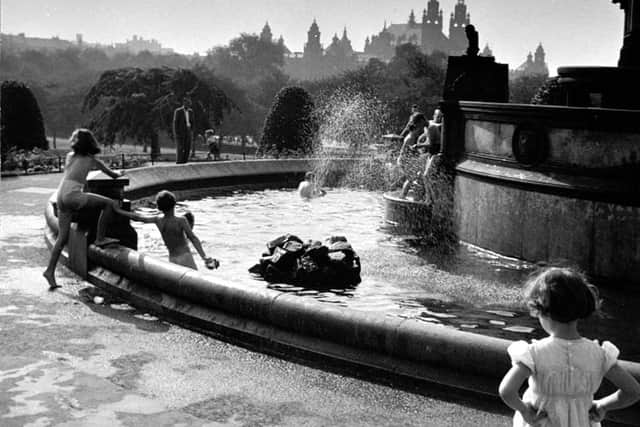
The Stewart Memorial Fountain: Arguably the park’s most ornate monument, the Stewart Memorial Fountain was erected in 1872 to commemorate Lord Provost Robert Stewart and Glasgow’s Loch Katrine water scheme. Its carvings include zodiac signs, aquatic creatures and scenes inspired by Sir Walter Scott’s Lady of the Lake.
The Lord Roberts Monument: The park’s most imposing sculpture is the colossal equestrian statue of Field Marshal Lord Roberts. Unveiled in 1916, it was described at the time as “the finest equestrian statue of modern times.”
The Bandstand and Amphitheatre: Built in 1924 and reopened after restoration in 2014, the Kelvingrove Bandstand remains one of Glasgow’s great outdoor venues.

The Snow Bridge: One of the park’s oldest surviving structures, the Snow Bridge dates from around 1800 and once carried Dumbarton Road before the modern Partick Bridge existed. It’s name comes from the fact that local residents would tip snow into the Kelvin from gates on the bridge while clearing the street.
The Pulham Rockery and Cascade: Installed for the 1901 Exhibition, this elaborate rock garden was created by Pulham & Son, the leading makers of artificial rockwork in Victorian Britain.
The Charles Wilson Granite Staircase: Near Park Gardens stands one of Glasgow’s grandest pieces of Victorian urban architecture: a monumental granite staircase completed in 1854.
The Royal Bengal Tigress: One of the park’s most unusual sculptures is Auguste Nicolas Cain’s bronze Royal Bengal Tigress with a Peacock, installed in 1867.
Along the Kelvin, Kelvingrove Park rewards visitors who slow down and look carefully. Near the river are the remains of Bunhouse Weir and Lade, relics of the medieval mills that once powered Glasgow’s economy. Nearby lie traces of Clayslaps Mill. The Chalybeate Spring Well, now dry, recalls a time when mineral springs and hydrotherapy attracted visitors seeking health cures.
Elsewhere, memorials and statues tell stories of Glasgow’s intellectual and military past. Visitors can find monuments to physicist Lord Kelvin, antiseptic pioneer Lord Lister and writer Thomas Carlyle, alongside memorials to the Cameronians regiment and Highland Light Infantry.
In the twentieth century the park added bowling greens, playgrounds and a skateboard park. Despite changes, Kelvingrove still retains the essential character Paxton imagined: a carefully composed landscape where architecture, sculpture, water and greenery work together to create a civic stage set beside the River Kelvin.