
Great Glaswegians: The eccentric Govan musician and poet who inspired The Beatles

Ivor Cutler’s audience of fans, scattered but fiercely loyal, has included The Beatles, Elvis Costello, John Lydon, Billy Connolly and Norman Blake.
When Ivor Cutler arrived on British television in the early 1960s, dressed like a man who had stepped out of a slightly incorrect century, viewers didn’t quite know what to do with him. He sang short, odd songs. He recited miniature poems like secret instructions. He delivered surreal moral lessons with the deadpan authority of a town clerk reporting on clouds.
Cutler, who died in 2006, never fit the entertainment industry in the conventional sense. But that, of course, was exactly the point. He became a cult figure, building a career on whimsy, restraint, and an eccentric approach to music and poetry.
Born Isadore Cutler on 15 January 1923, he grew up in Govan, Glasgow, in a middle-class Jewish family with Eastern European roots. He was educated at Shawlands Academy, and, by his own telling, his childhood shaped his sense of dislocation and his inner imaginative life.
Early biographical accounts depict a boy who did not easily conform to the world around him: sensitive, unusual, occasionally troubled, but unmistakably artistic. An observer of life. That sensibility never left him. If some performers used regional identity as a brand, Cutler made it a texture. His voice, pacing, comedic melancholy. The humour was gentle, but it came with an edge of lived-in experience.
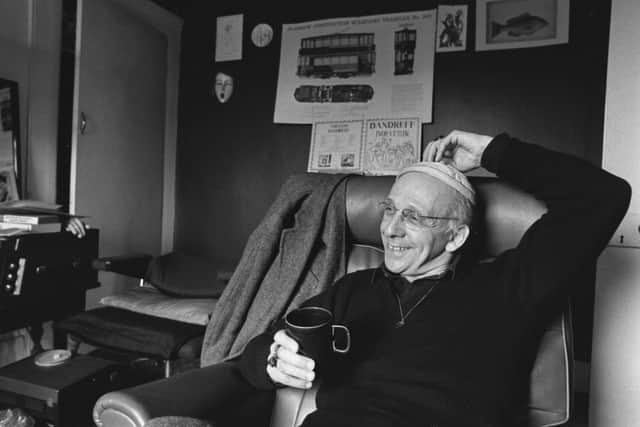

In 1942, Cutler joined the Royal Air Force as a navigator, only to be grounded for “dreaminess”. He became a teacher in schools in Glasgow and Paisley, before moving on to Summerhill school in Sussex, teaching music, drama and poetry. Cutler continued to teach until 1980 for the Inner London Education Authority. He lived in a cluttered flat full of curios in Parliament Hill Fields, north London.
His work - songs, poems, drawings, small manifestos - felt like communications from a parallel existence. Cutler began performing on BBC radio in the late 1950s and quickly became a regular presence. His pieces were short, carefully shaped and oddly memorable.
His signature harmonium became inseparable from his persona, as did his unusual stage-wear. In a career full of unlikely turns, none is more visually famous than Cutler’s role in The Beatles film Magical Mystery Tour in 1967, where he appears as the bus conductor, Buster Bloodvessel.
Paul McCartney saw Cutler on Late Night Line-Up and promptly invited him into the Beatles’ orbit. He became a favourite performer whose sensibility aligned with the band’s post-Revolver embrace of the surreal. After the film, Cutler recorded an album, Ludo, that was produced by long-time Beatles collaborator George Martin.
Paul McCartney, in his book The Lyrics, writes: “I think the first line of Country Dreamer is a nod to Ivor Cutler, a brilliant Scottish poet and songwriter who once described himself as an ‘oblique musical philosopher.’ Like me he was a sucker for the surreal.” John Lennon cited Cutler as an early influence on his own songwriting.
Cutler continued in his own lane, writing and releasing work across decades and maintaining a reputation for principled eccentricity. Cutler’s work feels quietly radical: small whimsical songs insisting that the small things in life are, in fact, the point.
From Govan to the Beatles’ tour bus, from classrooms to radio studios, Ivor Cutler built a career on a rare sort of integrity: the courage to remain mildly incomprehensible, and entirely himself.