
Inside the story of Glasgow’s House for an Art Lover as local landmark celebrates 30 years

Conceived in 1901 by architect and designer Charles Rennie Mackintosh and his wife, the artist Margaret Macdonald Mackintosh, the house was never intended for the city where it now stands. Yet more than a century later, it has become one of Glasgow’s defining cultural landmarks - part museum, part architectural experiment, and part living arts venue.
The story of the House for an Art Lover one of persistence, artistic interpretation, civic ambition and the enduring influence of Mackintosh on Scottish cultural identity.
The origins of the house lie in a 1901 competition organised by the German design journal Zeitschrift für Innendekoration. Architects were invited to submit designs for a “Haus eines Kunstfreundes”, which translates as a house for an art lover. Mackintosh and Margaret Macdonald entered a portfolio of highly distinctive drawings that fused Art Nouveau elegance with an austere modern sensibility.
Although the submission was technically disqualified because parts arrived late and some drawings were incomplete, judges still praised the scheme for its “pronounced personal quality” and innovative unity between interior and exterior design.
Nothing was built at the time. For decades, the designs remained one of architecture’s great “what ifs”.
That changed in the 1980s when Glasgow structural engineer Graham Roxburgh proposed finally constructing the house in Bellahouston Park. Roxburgh had already worked on restoring Mackintosh interiors nearby and believed the unbuilt project deserved physical form. Planning began in 1987 and construction started in 1989.
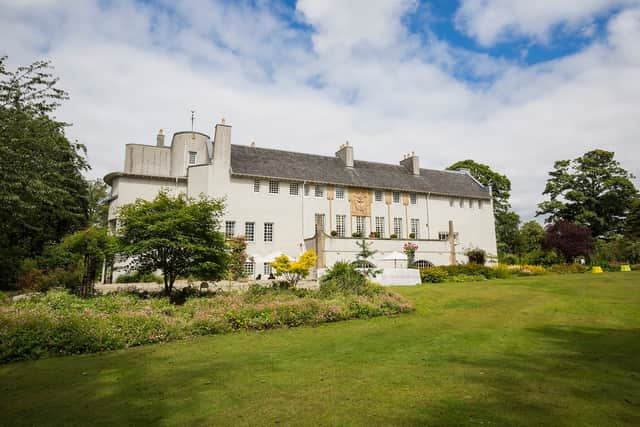

The project soon encountered financial difficulties during the recession of the early 1990s, forcing work to stop temporarily. Funding from Glasgow City Council and the Glasgow School of Art helped restart the project in 1994, and the building finally opened to the public in 1996 - ninety-five years after Mackintosh first imagined it.
The completed building is often described carefully as an “interpretation” rather than a strict reconstruction. Mackintosh’s original drawings were incomplete, meaning modern architects and craftspeople had to extrapolate details, materials and spatial arrangements. Architects John Kane, Graeme Robertson and Professor Andy MacMillan played major roles in translating the early twentieth-century designs into a functioning late twentieth-century building.
Externally, the building displays many hallmarks of Mackintosh’s architectural language: roughcast white walls, geometric masses, dramatic chimney stacks and carefully arranged windows that create rhythm rather than symmetry. The structure balances solidity and delicacy, with influences ranging from Scottish baronial architecture to Japanese design and continental Art Nouveau.
Inside, the house unfolds almost cinematically. Mackintosh believed architecture should be experienced sequentially, and the layout guides visitors through a progression of mood, colour and light.
The entrance hall establishes the atmosphere immediately, with restrained decoration and elongated vertical forms drawing the eye upward. From there, the interiors become increasingly expressive.
Among the most celebrated spaces is the double-height Music Room, perhaps the emotional centre of the building. Rendered almost entirely in white, silver and muted tones, it is filled with delicate geometric ornament and elongated furniture designs characteristic of Mackintosh and Margaret Macdonald’s collaborative style.
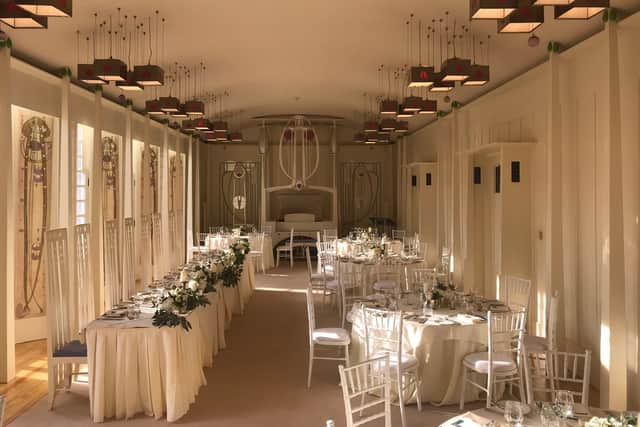
The Oval Room provides contrast. Softer and more organic in form, it demonstrates Mackintosh’s fascination with curved spaces and controlled natural light. Elsewhere, the Dining Room uses darker timber and heavier detailing to create warmth and enclosure, reflecting the architect’s recurring interplay between masculine and feminine aesthetics.
Other rooms are comparatively restrained but continue the same total-design philosophy. Mackintosh treated furniture, lighting, stained glass and decorative panels as integral parts of the architecture rather than accessories. Margaret Macdonald’s influence is especially visible in the symbolic floral motifs and gesso panels that soften the building’s geometric discipline.
Unlike many preserved historic interiors, the House for an Art Lover was designed from the outset to function as an active cultural space. Today it operates as an arts centre, wedding venue, event destination and educational resource.
Its galleries host contemporary art exhibitions, while the building itself serves as a venue for concerts, conferences, lectures and weddings. The café and event spaces attract visitors who may initially come for hospitality but leave having encountered one of Scotland’s most important architectural projects.
Educational programming has also become central to its mission, with workshops, guided tours and design activities aimed at introducing new audiences to Mackintosh’s work and the wider Glasgow Style movement.
Since opening in 1996, the House for an Art Lover has steadily evolved from an architectural curiosity into a major component of Glasgow’s cultural infrastructure.
Its arrival coincided with a wider international revival of interest in Mackintosh. Throughout the late 1990s and early 2000s, Glasgow increasingly positioned itself as a city of architecture and design, culminating in recognition as the UK City of Architecture and Design in 1999.
Over the last three decades, several developments have reinforced the house’s importance:
The continuing restoration and reinterpretation of Mackintosh buildings across Scotland, including the restoration of the Willow Tearooms and conservation work at the Hill House, helped place the House for an Art Lover within a broader heritage movement.
The devastating fires at the Glasgow School of Art in 2014 and 2018 intensified public appreciation for surviving Mackintosh-related sites. As restoration debates continued, the House for an Art Lover gained additional symbolic importance as one of the few large-scale Mackintosh interiors accessible to the public.
Most architectural landmarks are products of their own time. This one emerged from a conversation between eras: conceived in the optimism of 1901, rescued by civic ambition in the 1980s, and continually redefined by modern Glasgow.
House for an Art Lover, 10 Dumbreck Rd, Bellahouston, Glasgow G41 5BW