
Sight Scotland Veterans: Combat veteran who lost an eye now helps others with visual impairment
Steven Williams, a former soldier who lost his eye after being injured during a patrol in Kenya, is determined to use his story to inspire others to support Sight Scotland Veterans.
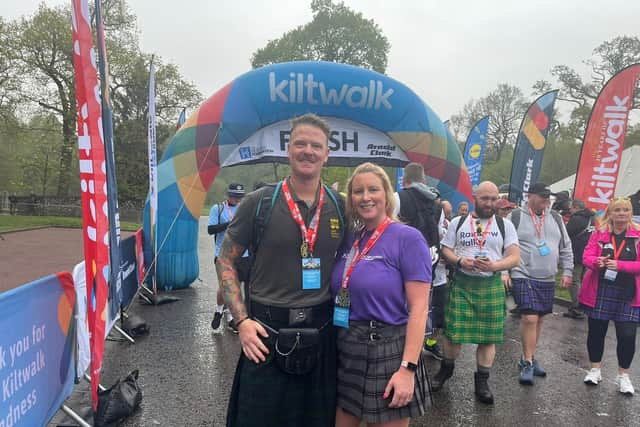
Steven, aged 42, who has been supported by Sight Scotland Veterans since being medically discharged from the army in 2011 and now works for the charity as an independent living worker, is taking on four Kilt Walks in 2025, in Glasgow, Edinburgh, Aberdeen and Dundee.
He is taking on this 80-mile walking challenge, alongside his partner, to highlight all the great work Sight Scotland Veterans does and to say thank you to a charity that has done so much to help him both personally and professionally.
He explains: “Sight Scotland Veterans is a fantastic charity. It supported me in my time of need, and now I want to give back. I really want to raise awareness of the great work the charity does, as too many people with vision impairment suffer in silence and we all need some support at different times. You can find yourself lonely and isolated, which can affect your self-esteem and confidence.

"I have been there myself. Without the help of this charity, I genuinely don’t know where I would be. Every veteran in Scotland living with sight loss, no matter their age or where they are, needs to know that a variety of help is available through Sight Scotland Veterans.
“I served ten years in the Army, starting with the Royal Scots. I did a couple of tours in Iraq and each one was completely different. The first was intense combat, modern day warfare. The second was more about training the Iraqi Army to be self-sufficient and allow the British Armed Forces to leave. There were some hairy moments along the way, we got blown up by an Improvised Explosive Device (IED) in the back of a FV510 Warrior, an armoured vehicle, during one patrol down “Route Irish” which is a 7.5mile stretch from the Green Zone to Bagdad’s Internation Airport.
"The FV510 Warrior was immobilised when an IED detonated at the front, striking the engine, if it hadn’t, I wouldn’t be here to tell the story. Our training automatically kicked in and we secured the site but thankfully there was no secondary fire.
"I returned from that seven-month tour in March 2008, and by early summer, I heard The Black Watch were seeking a 30-man platoon from other Scottish regiments for their upcoming deployment to Afghanistan. I loved the Army and, naively feeling invincible, volunteered for transfer to The Black Watch. Part of our training took place in Kenya, where the terrain and heat mirrored conditions in Afghanistan.
"After four weeks in the field near Nairobi, a branch snapped back during a patrol and struck me in the eye. There was no blood, and you couldn’t really stop, so I kept going, but by morning I couldn’t see. I was CASEVAC (casualty evacuated) from the field and taken to hospital in Nairobi where they removed part of the thorn. I flew back with a field doctor having drops put in my eye every fifteen minutes during a ten-hour flight.
“Back in the UK, and I remember being in Heathrow and I was still wearing my dusty and dirty camouflage clothing, and the field doctor went into one of those fancy designer shops and bought some “civvy” clothes. I went to Moorfields Eye Hospital in London to stabilise my eye and I was transferred to Birmingham and Midland Eye Centre for a week before returning to my unit in Edinburgh.
"I still had the eye, but I had no central vision. Over the next two years, I went through twelve operations, everything from treating cataracts to infections and high pressure. The doctors didn’t really know what to do. Eventually, they gave me a choice of keep undergoing treatments and medication or to remove the eye. I made the difficult decision to have it taken out in May 2011, and the following week I was told I was no longer “fit to serve.” I was gutted, but after two years of being unable to serve as a soldier due to my injury, I felt ready to leave the Army, but it was still daunting.
“After that, things got extremely hard. I started to feel sorry for myself and I didn’t know what to do. I essentially lost my eye, my job, my purpose, and I felt completely lost. It was around this time I started to get help from Sight Scotland Veterans and my independent living worker in Midlothian was amazing. She supported not just me, but also my partner and our children. That meant the world, because when a veteran loses their sight, the whole family is affected. Until I had my eye removed, people didn’t even understand that I was injured. It was invisible, and that made it even harder to deal with.
“I was fitted with a prosthetic eye, but it was so uncomfortable, and I was told I would need yet another operation on my eye lids and I couldn’t face it. So, I spoke with my family, and we all agreed that if I was OK with how I looked (without the prosthetic eye), I didn’t need it. But even now, I struggle. I am not classed as legally sight-impaired, but my sight loss affects me every single day.
"It’s still hard walking downstairs, judging distance, even noticing someone coming from the side, I’m constantly worried about bumping into things. I also struggle to shave one side of my face, and taking part in video meetings is difficult without becoming self-conscious. I cannot escape the fact that I’ve lost my eye. I spent ten years pretending I didn’t have sight loss; I was embarrassed by it. But over time, I’ve tried to be a bit kinder to myself.
“The support I received from Sight Scotland Veterans was invaluable. They encouraged me to get involved with the community again. I started by volunteering to coach my son’s football team. That led me to the Lothian Veterans Centre where, after seven months of volunteering, I was offered a part-time job as an employability officer. Eventually, I became the operations Manager for four years.
"It was a rewarding but demanding role, often supporting people in crisis such as facing job loss, homelessness, or struggling with their mental or physical health. I was regularly contacted out of hours, even on Christmas Day, and often neglected my own wellbeing. All this time I wasn’t dealing with my own sight loss, and my mental health began to suffer. Throughout this time Sight Scotland Veterans remained a constant support.
“I took voluntary redundancy from Lothian Veterans Centre in May 2019. Like many small charities reliant on annual grants, we had to reapply for funding but were unsuccessful. Deep down, I realised I needed a break. This became a real turning point for me. I took time to re-evaluate my life and even began exploring mindfulness and yoga. Around nine months later, I successfully applied for a role with Sight Scotland Veterans as a centre worker and started at Linburn in 2020, just a week into lockdown. I loved working there over the next four years, helping veterans rebuild their lives after the pandemic.
"In August last year, I started a new role as an independent living worker for Fife, and I thoroughly enjoy helping veterans live as independently as possible and reconnect with their communities. I know first-hand how vital this support is, especially for those experiencing sight loss for the first time or facing significant changes. Some conditions sadly worsen over time, so reassessment is crucial.
"I always ask myself: how can we make a meaningful difference? What do they truly need? Often, it’s the small, everyday tasks, like safely making a cup of tea, that matter most. We provide training and equipment to support this, helping people maintain independence at home. Our team also offers expert support with more complex issues like housing, finances, and wellbeing. Through our centres, sight support groups, and digital hub calls, we provide social connection and camaraderie - and the chance to share our lived experiences, which I believe is invaluable."
Steven has also recently joined the Sight Loss Councils in Scotland, which are led by blind and partially sighted people who use lived experience to tackle local and national issues to improve the accessibility of services.
If you have been inspired by Steven and would like to take on your own challenge to help support Sight Scotland Veterans, please visit sightscotland.org.uk/veterans or call 0800 035 6409.