
The Duke of Wellington and the traffic cone: Banksy's favourite work of art is in Glasgow

When famed graffiti artist Banksy named their favourite work of art in the UK, it was a Glasgow landmark.
The most famous graffiti artist in the world returned to Glasgow last year for a retrospective exhibition spanning 25 years of his work. The Cut & Run show at the Gallery of Modern Art attracted 180,000 attendees during its ten-week run. The exhibition showcased stencil graffiti by Banksy from between 1998 and 2023. Banksy’s association with the city stretches back to at least 2001 when a Peace is Tough exhibition showcased early work including Monkey Queen. There’s still the faint imprint of a Banksy stencil on Midland Street, outside where The Arches entrance once was.

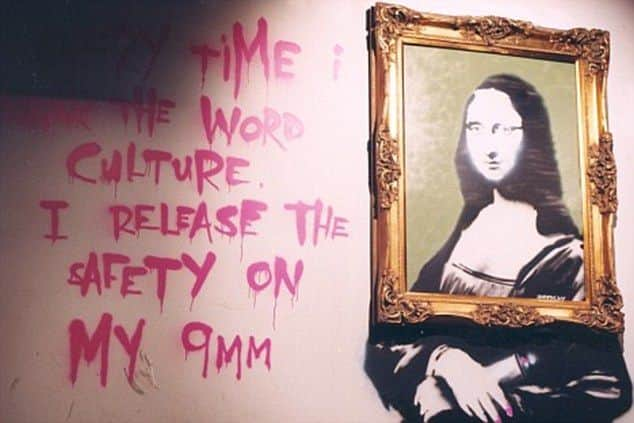
There was an attempt in 2018 to restore a mural inside Platform at The Arches of Mona Lisa surrounded by a picture frame, a gun-toting monkey wearing a tutu, and the words “Every time I hear the word culture, I release the safety on my 9mm” written between them. It had been painted over with grey emulsion paint after the Peace is Tough exhibition.
In Banksy’s first collection of graffiti, Banging Your Head Against A Brick Wall, published in 2001, there is a photograph of a stencil entitled Cheeky Monkey outside The Garage on Sauchiehall Street outside Mr Chips.
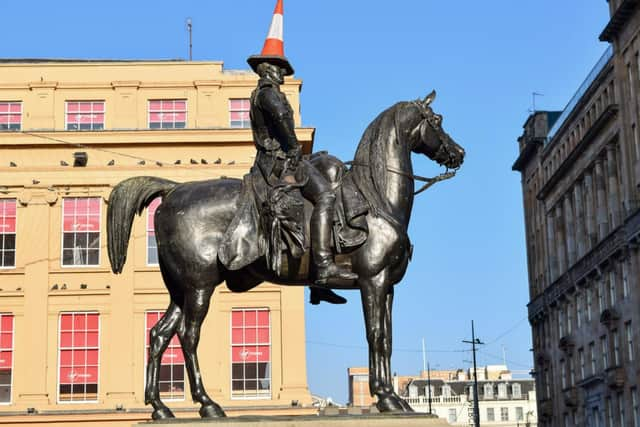
Then, in Banksy’s book Wall and Piece from 2005, he included a photograph of the Duke of Wellington statue outside of Glasgow’s Gallery of Modern Art alongside a picture of his own work, The Drinker.
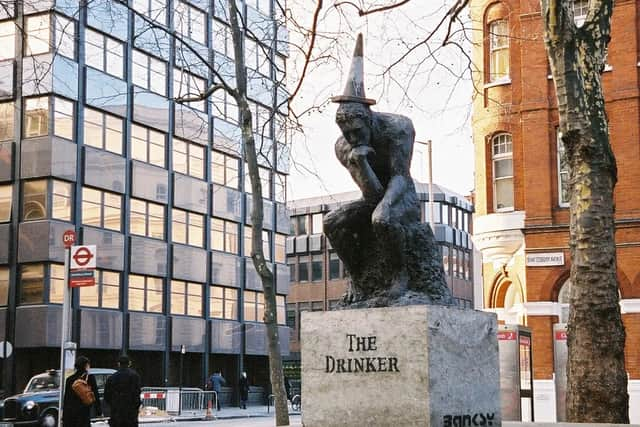
Banksy said: “If you want someone to be ignored then build a lifesize bronze statues of them and stick it in the middle of town. It doesn’t matter how great you were, it’ll always take an unfunny drunk with climbing skills to make people notice you.”
When introducing the retrospective show, Banksy outlined why Glasgow and specifically the Gallery of Modern Art at Royal Exchange was chosen for the officially sanctioned exbibition’s debut.
The artist said: “Welcome. If nothing else, you’re going to see one masterpiece today - you just walked by it.
“For anyone who isn’t aware - the statue out the front has had a cone on its head continuously for the past 40 odd years. Despite the best efforts of the council and police, every time one is removed another takes its place.
“This might sound absurd and pretentious (just wait until you see the rest of the exhibition) but it’s my favourite work of art in the UK and the reason I’ve brought the show here.”
The tradition of placing a traffic cone on the head of the Duke of Wellington statue, and occasionally on the head of his horse Copenhagen, is thought to have been started by late night revellers during the 1980s. It’s become a symbol of the local sense of humour and irreverent mindset. Visitors of the city peer up at the traffic cone and have their picture taken in front of the statue every day.
Gareth James, manager of the Gallery of Modern Art, said: "That notion of an anonymous art intervention is quite in common with Banksy. And I think Banksy has picked up on that spirit of Glasgow of being a wee bit reckless and just getting on with it.”
A council plan to raise the plinth of the statue in a bid to end the tradition was dropped in 2013. Officialdom takes a dim view of the placement of the cone yet doesn’t shy away from using the statue in its amended form to promote the city.
Arthur Wellesley, the Duke of Wellington, is famous for defeating Napoleon at the Battle of Waterloo in 1815 and later becoming prime minister. His unexpected legacy is a local tradition that has now spanned four decades.