
Bus Franchise Glasgow: First step towards public control of buses but it could take seven years
The first step towards returning the bus network in Glasgow and surrounding areas to public control has been taken, but what comes next?
Strathclyde Partnership for Transport (SPT) will now hold a consultation on the future of bus services across the region. Franchising could allow SPT to set routes and fares and contract bus operators to run them.
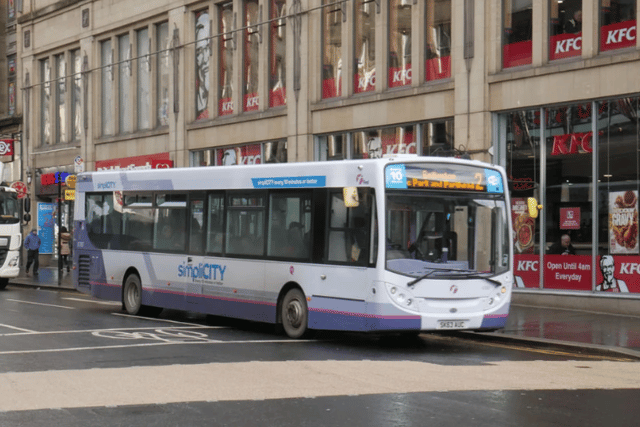
Changes are proposed as there are “significant concerns in terms of the efficiency, performance, affordability and overall sustainability of the bus network in Strathclyde”, an SPT report stated.
But it could cost £15m, and take five to seven years, to get franchising to the point of implementation.
Cllr Stephen Dornan, SNP, the SPT chairman, said investment was needed from the Scottish Government, which has to “step up with real funding and a commitment to support public transport, particularly bus which for too long has been forgotten”.
He added SPT’s plans are “bold and ambitious”, setting “a strong approach to tackle a declining bus market”.
Bus firm McGill’s has threatened legal action over franchising, which it described as “theft of private business”. However, campaigners, who rallied outside the SPT offices on Friday, want to see the transport body move faster on public control.
They wanted Bus Service Improvement Partnerships (BSIPs) — which involve working with private operators to improve services — to be dropped.
Cllr Holly Bruce, Greens, put forward a motion to the SPT meeting which supported the campaigners’ call. She said franchising, and municipal bus ownership, would “truly transform” the network and “hopefully make buses more affordable, accessible, convenient”
However, she believes the inclusion of BSIPs “only serves as a distraction and embeds further delays in SPT starting the franchising process”. Her proposal was defeated by 14 votes to three as councillors on the board agreed to proceed with the recommendations of officials.
One official said franchising would “deliver the transformative level of change required. BSIPs “won’t do that but provide a basis for us to do something in the interim”, he said, adding they can “stop some of the decline, generate growth and get stability to the network”.
He also said there are “really good operators” in the private sector who “should not be forgotten about” and would still be required under a franchising model.
The approved recommendations state franchising provides “the greatest certainty of making significant improvement to the network to achieve passenger growth and better accessibility for all”.
However, the cost of getting to point of implementation is around £15m, could take five to seven years and requires “financial support from government”. Officials recommended BSIPs are used to “arrest further passenger decline and improve the bus network over the medium term”.
Small-scale municipal bus companies were also included in the recommendations, which could provide “socially necessary services in parts of the region where private operators are currently very limited”.
Work on Bus Partnership Funds, which see investment in bus priority measures, should also continue, the report stated, to “improve the attractiveness of buses compared to private cars”.
However, officials said the Scottish Government has paused the fund in 2024/25 — and “reduced SPT’s capital programme to zero in 2024/25, thereby removing two potential sources of funding for investment”.
Public consultation on the recommendations is planned to start in April. SPT chief executive Valerie Davidson said the issue “about how we ultimately fund whatever goes into the strategy is for the next stage”.
McGill’s CEO, Ralph Roberts, previously said franchising is “effectively confiscation of a business that has been built in good faith over many years with investors’ funds and it raises a host of legal implications”
He added: “It goes against every sense of natural justice and we would take this to every court in the land and beyond.”
During the SPT meeting, Cllr Malcolm Mitchell, SNP, said: “It’s a topic that gets a lot of passionate views, on one hand we’ve got over 10,000 people [a petition] saying we should pursue franchising.”
He added, on the other hand, a “senior officer” from one of the bus operators’ comments had been “bordering on hysterical”.