
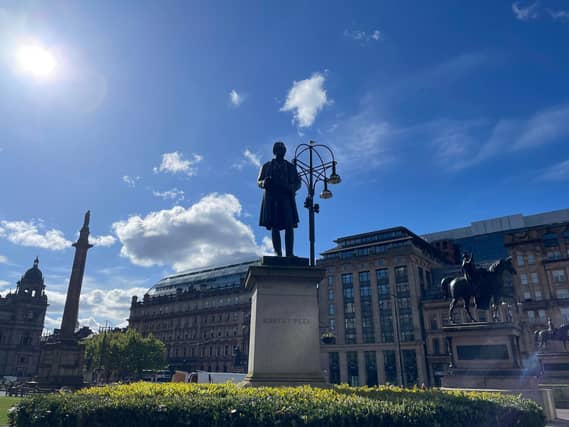


If you have passed by George Square recently you will have noticed that the perimeter hoardings are now in place - a start to its 18-month redevelopment. This month we will see the Square's statues being removed for restoration and storage by contractor Rupert Harris, before the Square is then handed over to the public realm contractors Rainton Construction who will begin carrying out the main restoration works from the start of June.
The taxi rank in front of the Millenium Hotel will remain in place during the construction of the Square. Pedestrian access around the Square will also be maintained around its outer pavements. The work on George Square will deliver a new stone surface throughout; informal play areas for children in sensory gardens in the eastern area; a raised lawn platform; new trees species will be planted to add to the existing Norway maple and cherry trees in the Square; new seating added to the remembrance benches; and feature lighting. A water feature was dropped from the final plans due to budget restrictions.
The first statues removed was a figure of Robert Burns. The 11 statues will undergo restoration before being returned to the finished square from July 2027. Work will be carried out over two phases, with George Square, St Vincent Place and West George Street due for completion by August 2026. Cochrane Street and sections of George Street and North Hanover Street are set to be finished in spring 2027. The location of the statues in the revamped square has not been confirmed.
You can read more about the history behind the 11 statues in George Square below.
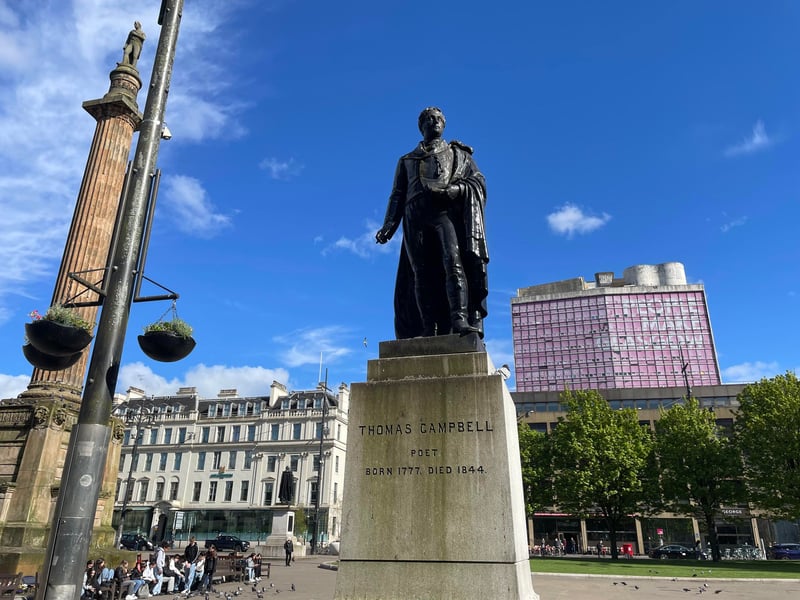
5. Thomas Campbell
Scottish poet, historian and political commentator Thomas Campbell was born in Glasgow in 1777 and was educated at Grammar School. In November 1826, Campbell was elected to the Lord Rectorship of Glasgow University. The unveiling was performed by Dr James A. Campbell on the centenary of the poet’s birth. | Declan McConville
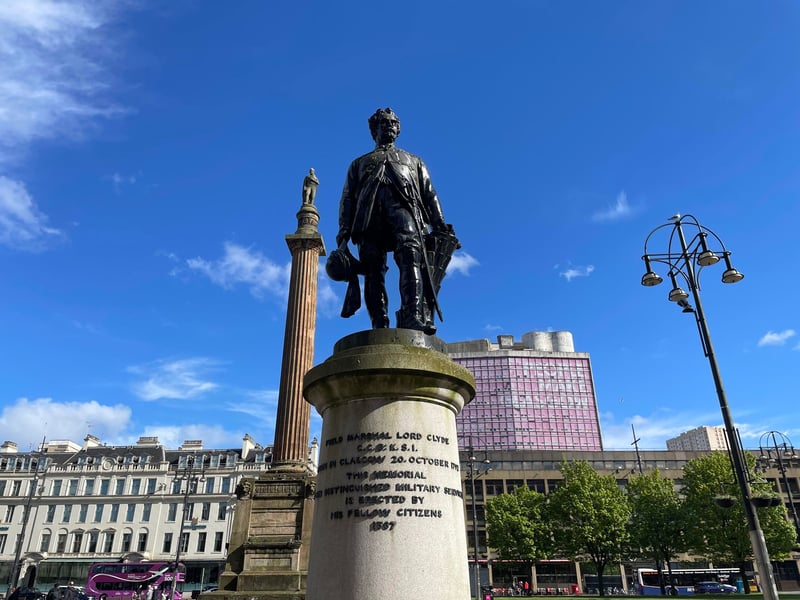
6. Lord Clyde
Military leader Lord Clyde was the eldest son of Glasgow carpenter John MacLiver but was given his mother's maiden name. Sir Colin Campbell’s most famous exploit being his command of ‘Thin Red Line’ of the 93rd Highlanders, which repulsed the Russians at the Battle of Balaclava in October 1854. His statue, by John Henry Foley, was unveiled in George Square in 1868 but prompted mixed reactions. | Declan McConville
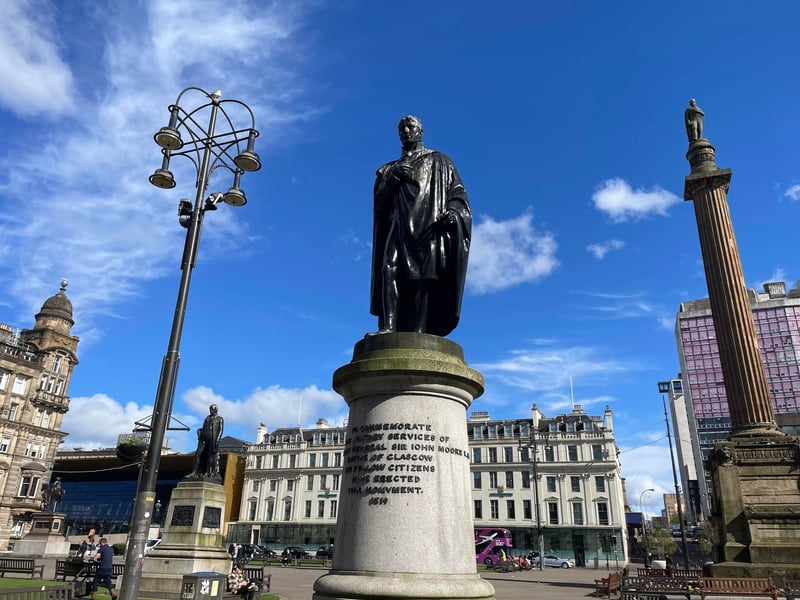
7. Sir John Moore
Sir John Moore was brought up in ‘Donald’s Land’, in the Trongate. Moore served as captain-lieutenant in the Duke of Hamilton’s regiment in America (1778-83) followed by a short period as MP for the united burghs of Lanark, Selkirk, Peebles and Linlithgow. His statue was unveiled on George Square in August 1819. | Declan McConville
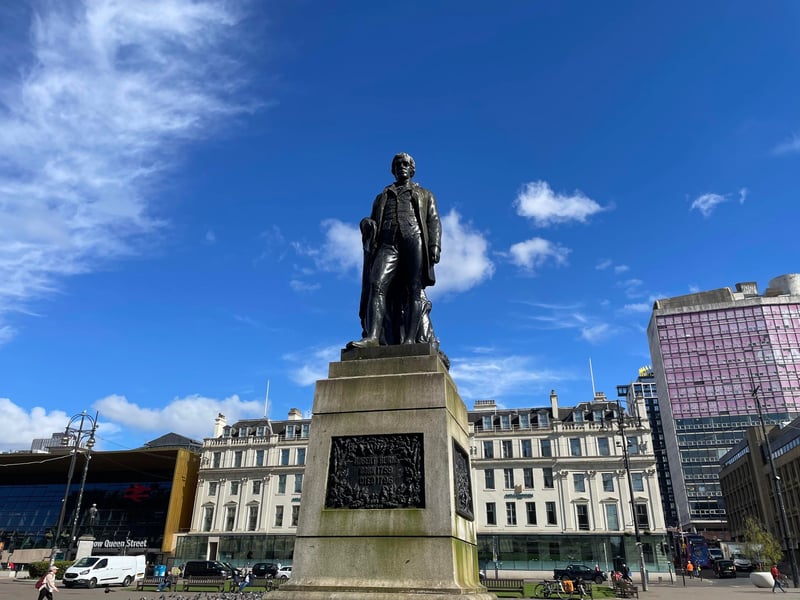
8. Robert Burns
Scotland's national poet Robert Burns' statue was designed by George Ewing and was erected in George Square in 1877. The monument was first under the care of the Dennistoun Burns Club, and was by them lovingly decorated on the anniversaries of the poet’s birth. | Declan McConville