
Glasgow councillors approve 63-home Barras development despite BAaD arts venue opposition
Committee backs Barra’s flat plans despite council officials recommendation
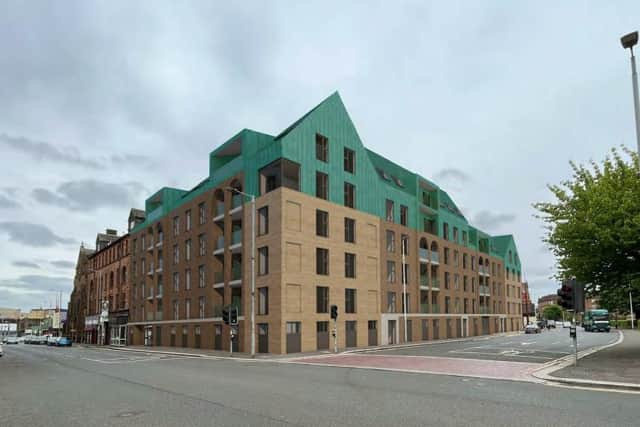
Over 60 flats can be built on the edge of the Barras — despite opposition from arts venue BAaD — after councillors voted against the recommendation of planners.
Spectrum Properties has secured permission to knock down buildings, including the Squirrel Bar, on a site at London Road, Stevenson Street and Bain Street.
Planners at Glasgow City Council said the project should be refused as it was not a “contextually appropriate or sufficiently high-quality development”. They were concerned about the loss of a sandstone building, previously used by charity Dream Machine, and the lack of ground floor commercial or cultural uses proposed.
But a tight 6-5 vote went in Spectrum’s favour as the city’s planning committee approved the scheme at a meeting today (Tuesday). Bill Roddie, managing director at Spectrum, appealed to councillors to “decide if anything will be built on this site”.
“The [sandstone] building will need to be demolished,” he said. “If the elected members grant consent this will start immediately. We are self-funded, it is not a speculative development.”
Nearby arts and events space BAaD had called for the proposal to be turned down, with founder Norrie Innes saying: “If this is granted, you are contributing towards the regression of the Barras market area and potentially its ultimate demise.”
He said residential use within the area “would, at this time, create an impediment to its progress”. Mr Roddie said other options, proposed by Mr Innes, were “not viable”.
The site includes a four-storey painted sandstone building, which was used by creative studio and community arts venue Dream Machine, and the single-storey Squirrel Bar. Spectrum intends to demolish both buildings to build 63 homes for private sale.
A council report stated the plans failed to show that existing noise, from places like BAaD and the Barras market, would be “acceptable for future residents” or that residential use could “coexist with these established activities… without creating pressure for operational changes, reduced event activity or additional controls”.

Addressing councillors, Mr Innes : “What is unique about Glasgow? The Barras is one of the primary aspects.
“People that come to the Barras, they can tell you it’s not what it once was, but we’re working so, so very hard to try and create a new contemporary version of the Barras, respecting the past, being true to its culture and identity, but evolving.”
He said BAaD has a waiting list for vacant units which showed there is demand for cultural space in the area.
Mr Roddie said: “We have looked at the ground floor properties for rental and we have had various reports that suggest there is no demand for retail or ground floor properties within that area.”
He added the sandstone London Road building couldn’t be saved, saying: “The construction of the building was poor from the get-go.”
READ MORE: Plans to build over 60 flats at the Barras recommended for refusal over arts venue impact
Jon Jewitt, from Jewitt & Wilkie Architects, said the applicants were “certainly not saying that BAaD should turn its volume down” and that “urban noise background” was to be expected in “vibrant areas”.
Planners will now draw up conditions of the consent, including on noise mitigation, which will go back before councillors for approval.
Councillor John Daly, Conservative, proposed the application was approved. He said the committee had to consider “vying responsibilities” of housing demand and preserving heritage.
“How people choose to live, in what dwellings, is very much their business,” he added. “If they choose to buy a ground floor residence, which faces towards the street, that is their business.”
Cllr Daly said the project would bring 63 extra homes to the area during a housing crisis, and 63 “spending families” is “always to the economic good of an area”.
Councillor Ken Andrew, SNP, the committee chairman, said he was concerned “about the quality of those ground floor flats”. “Glasgow in the past has been blighted by poor design, some poor buildings, I certainly don’t want to be part of that heritage,” he said.
Over 120 objections had been sent to the council, with many from former users of the Dream Machine venue.