
Dear Green Place gets a little greener with new floating islands
Volunteers deliver new life on old plastic
Winter may be coming, but that hasn’t stopped green-fingered enthusiasts from digging deep to nurture new growth for Glasgow’s future.
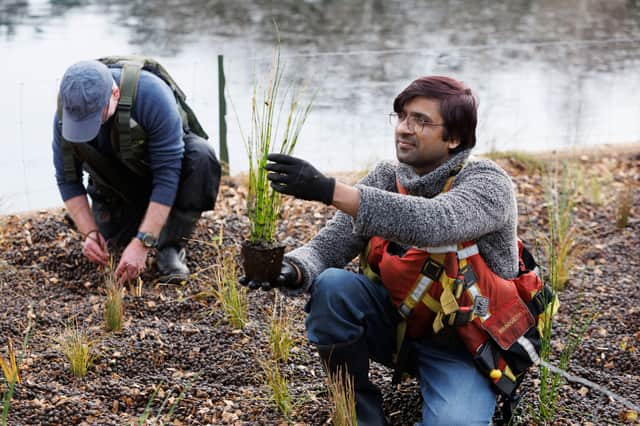

Thanks to organisers of the Glasgow 2026 Commonwealth Games floating gardens are appearing round the city.
Seven new floating islands, planted by community groups, have been installed around five Glasgow sites. These eco-islands are designed to help improve water quality, promote biodiversity and provide nesting sites around Glasgow.
Combined, the islands cover 248sqm across four Glasgow parks - Elder Park in Govan, Richmond Park in the east end, Victoria Park in the west end and Queen’s Park on the southside - as well as Hogganfield Loch nature reserve. The islands are designed and installed by Forres-based bio-engineering firm Biomatrix Water Solutions.
The legacy is a central part of Glasgow 2026’s objective to create a greener Games. Glasgow stepped in to host the Commonwealth Games at the 11th hour when Australia’s Victoria State pulled out blaming spiralling costs. Glasgow, which hosted a celebrated Games in 2014, put together a scaled back event, with 10 events in existing venues. They also scaled back the carbon footprint during July and August. They delivered just one-fifth of the carbon impact of the previous Games in Birmingham in 2022.
The eco-islands, built using recycled plastic, are now bursting with plants native to Scotland, including Marsh marigolds, water forget-me-nots, water mint, bullrushes, reeds, sedges and bullrushes.
Environmental engineer Ellen Hebdon, of Biomatrix Water Solutions, said: “One of the things we do with projects like these is getting communities involved with installations. People from all walks of life come and get planting.
“Algae is toxic, especially blue algae, and it smothers other things in the water. It’s not nice stuff. These islands are biomimicking a riparian edge, the natural edge of a river or a lakeside.
“There’s always work being done under the water but also work above the water by fungus, pollinators, all sorts of invertebrates raking around in the substrate, then ducks and small birds will move in. It’s great to see.”
“I hope what we’re doing will encourage people to take time to pause for a minute, and have a think and appreciate that they have something really nice.”
George Black Chair of Glasgow 2026, said: “The Games was experienced across the city for 11 days, but our commitment to Glasgow goes much further. As an event organiser, we wanted to give back to the host city and the communities that made Glasgow 2026 so special.
“We made decisions in designing this Games to reduce our environmental impact. As the first event as part of Commonwealth Sport’s reimagined model, we are proud to have worked with Glasgow City Council and Bupa to leave a lasting legacy in the communities that welcomed the Commonwealth so warmly.”
An estimated 1million fans visited Glasgow for the Games. Despite concerns about the city being unready and in the grip of major roadworks and renovation - with George Square closed off for refurbishment - the event was lauded as a success.
The next instalment of the Commonwealth Games is scheduled for Amdavad, India in 2030.