
I joined First Minister John Swinney on the campaign trail in Motherwell

The Scottish National Party leader visited the new Motherwell, Wishaw and Carluke seat with candidate Marion Fellows.
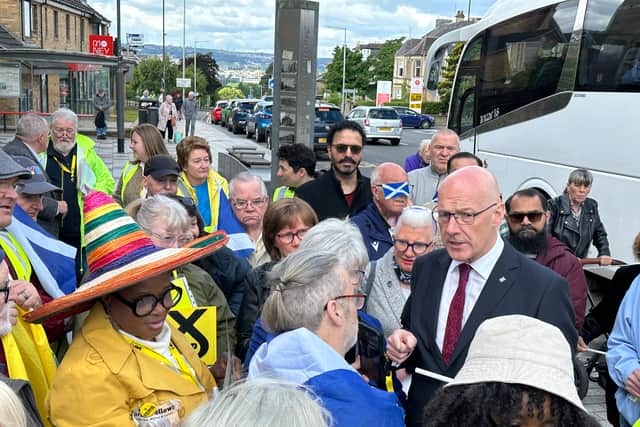
It’s easy to spot First Minister John Swinney outside Motherwell Library. His tall, thin frame is surrounded by a throng of supporters carrying yellow SNP placards. Some are wearing sombreros. There’s saltire flags and Scottish head gear. Every now and then a cheer goes up as the First Minister crisply delivers a campaign line.
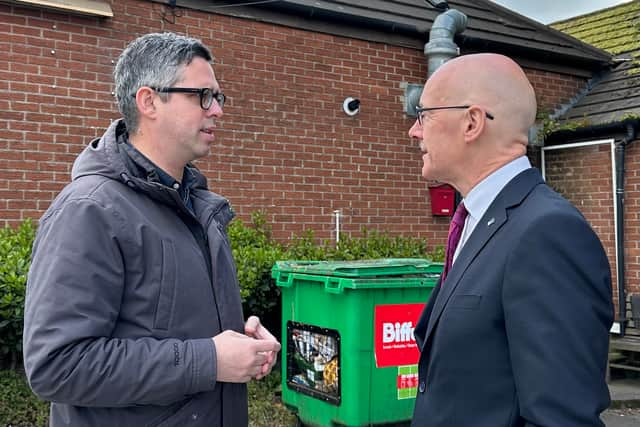
The Scottish National Party leader is in the new Motherwell, Wishaw and Carluke seat with candidate Marion Fellows. He pauses to answer questions from an independence campaigner livestreaming the gathering on social media. Yesterday the First Minister had navigated his way through five constituencies, today it is just this one campaign stop. While rallying the local party, he also remarked on the spending plans presented by both Labour and Tories, saying both parties are debating the UK's eonomic future in a “parallel universe”, ignoring warnings from experts, he says, about the harsh reality of a damaging decade of cuts. Due to the adversarial nature of our parliamentary politics, we’re used to seeing a combative John Swinney answering questions at Holyrood. He’s less animated in person, measured and precise in what he says and seemingly calm in the face of a general election that is potentially calamitous for SNP candidates in and around Glasgow.
In North Lanarkshire and across Glasgow, voters can either expect a Labour candidate or an SNP candidate to be their next representative at Westminster. In the context of concerns over what government spending will mean for public services in Scotland, I asked the First Minister how an SNP MP will be able to advocate for the people of Motherwell and Greater Glasgow. “What's important is that people are aware before they cast their vote, that they know what the choice actually involves. The Labour Party needs to be open about the fact that they are essentially accepting the same fiscal discipline that the conservatives are applying, which involves, as the Institute for Fiscal Study says, £18 billion of spending cuts - they won't set out where they're coming from.
“Now I've come back in as First Minister, I can see the enormous pressure that the public finances are under. If the public finances are under pressure, public services are under pressure as well. So we cannot tolerate spending cuts of that nature. So we need a different course.
“I've got an argument for that, which is that Scotland should be independent, we should make our own fiscal decisions that we don't have to be a bound by the considerations that the Labour Party is bearing in mind, but in the context of the next House of Commons, SNP MPs will be able to argue against that austerity.
“If we have a strong body of SNP MPS elected in Scotland, that is a message to any incoming Labour government. And I think we're getting a Labour government, the Tories are completely finished. That Labour government has got to listen to the mood in Scotland, which says we want no more spending cuts.”
What does he think are the priorities for people in Motherwell, Carluke and Wishaw? “I think the agenda that I'm pursuing in government is about eradicating child poverty and that’s very relevant to communities here, where the eradication of child poverty enables the next generation to get the best start in life.
“We've got various interventions, the expansion of early learning, childcare, the Scottish Child Payment, the baby box. These are all about getting children to have the best start in life, but we are having to implement them against the tide of spending cuts and austerity from our UK government. So what I hope is that we get a UK government that will be more sympathetic to that direction of travel about the eradication of child poverty so that we are not having to swim against the tide.”
“I think that's crucial to boosting the possibilities for children in Motherwell and mu. Second thing, is that we've got to take steps to stimulate the economy, and we do, again, as much as we can within our powers, but Brexit, for example, is damaging the economic fabric of communities like Wishaw and Motherwell. So we need to get a investment into public infrastructure, investment into skills.
“We've had this austerity experiment for 14 years, spending cut after spending cut, and it's not grown the economy. So we've got to stop doing it because what we demonstrated in government after the financial crash in 2008 is if you invest in the economy, you can lift the prospects and the possibilities. So that's the strategy that I want to see pursued.”
The issues and priorities may vary across constituencies but this general election plays out against the ongoing conversation about constitutional matters. While John Swinney can point to independence as part of his strategy, parties that are committed to the union point to the redevelopment of Ravenscraig, Centre One tax office in East Kilbride and the Cabinet Office based in Glasgow as evidence of a dividend of being part of the UK. How does the SNP focus attention back onto the benefits of an independent Scotland?
“Well, all these examples you've cited, including Centre One and the Ravenscraig development, these are all things that an independent Scotland's going to require. They make my point, they're about investment in the locality. And my economic outlook is that you invest to grow. If you cut, you'll contract. So these measures are all welcome and an independent Scotland's going to have to have departments of government's and will have centres of excellence.
“One of the major strengths that Scotland has today is we've got a vibrant college and university sector, which is generating really good, strong new opportunities within our country, partnering with business, and if we encourage and motivate as much of that as possible, and we'll see further fruits of that. And of course at Ravenscraig you've got a new college infrastructure which is contributing significantly to the local economy.”
A dominant theme in this election cycle is an increasingly toxic narrative about immigration at Westminster. I asked how, as First Minister, Mr Swinney can ensure that immigrants here in Scotland feel welcomed.
“I am horrified by the discussion on immigration on two levels” he said. “Firstly, because how it makes people who've migrated to our country feel, and I want them to feel safe, secure, and assured in our country, this is their home and they should feel safe and secure here. As a government, we take steps through our leadership to demonstrate that immigrants are welcome.
“And we also, through our education campaigns and the work at Police Scotland act to make sure that in our work and community integration that makes people feel safe within our society.
“The second point is on economics. We have got in this community, there'll be people who are unable to get out of hospital because there isn't a care package to support them in the community. Delayed discharges are at far too high a level. And the reason they are so high is not because there isn't the money to provide social care packages in the community. There aren't the people. And we lost so many people after Brexit who were providing care packages and care support within our community.
“This has been a long-term problem for Scotland of a declining working age population, and it was rectified in 2004 by the expansion of the EU to the east. And freedom of movement came in. Lots of people came here from Eastern European countries and they contributed to their economy.
“And actually the economic and population problem that Scotland was going to face didn't materialise because these people came and filled the void. A lot of them have gone away and now we've got the void back. So I despair about the debate about migration because not only is it deeply hostile to people and unwelcoming to people, it's also failing economically because population growth is what grows your economy.”
Glaswegians will head to their assigned polling place on Thursday, July 4 to cast their vote in a general election which will determine who leads the United Kingdom. You can find out more about the city’s preparations for the election here.