
Seawards the Great Ships: The first Scottish film to win an Oscar told the story of Clyde shipyards

When Seawards the Great Ships premiered in 1961, it captured a world that was already beginning to fade: the colossal shipyards of the River Clyde and the people who worked there.
Produced in Glasgow by Templar Films and directed by the experimental American filmmaker Hilary Harris, the 28-minute documentary celebrated the craft, labour and community of Clyde shipbuilders. A year later, at the 34th Academy Awards, the film achieved a landmark: it won the Oscar for Best Live Action Short Subject, becoming the first Scottish-made film ever to receive an Academy Award.
Written by Scottish documentary pioneer John Grierson with commentary by Cliff Hanley, Seawards the Great Ships chronicles the building of oceangoing vessels from design to launch across multiple Clyde yards, including Fairfield, John Brown and Scotts.
Rather than presenting a purely technical record, the film treats shipbuilding as spectacle. Harris’s camera explores cranes, riveters and steel plates with modernist abstraction: machinery becomes geometry, labour becomes choreography. Dialogue between workers appears spontaneous but was scripted, since authentic yard conversations were considered too coarse for audiences of the day.
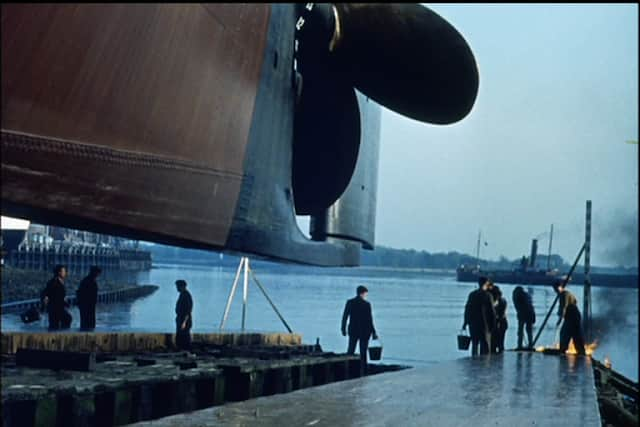

The result is both documentary and a cinematic monument to a workforce and industry that defined Glasgow identity for generations. The film concludes with a climactic launch sequence following a vessel as it slides into the Clyde for the first time - the visuals and camerawork was praised and the scene was described as “breath-taking” in contemporary reviews.
Janet McBain, for the British Film Institute, wrote for their archive, saying: “The film paid tribute to the internationally recognised achievements of Clyde shipbuilding. It was released at the beginning of a decade that was to see the River Clyde's long established predominance in world shipping slip into financial decline and human disillusionment - a decade that was to end with government rescue packages and the emotive years of the UCS 'work-in' - a workers' occupation of the yards in the fight to prevent their closure.
“This glorious swansong of shipbuilding on the Clyde could be said to epitomise documentary film craft in Scotland. The treatment was written by John Grierson, Scots pioneer of the documentary film, produced by Glasgow's Templar Films, and directed by young American Hilary Harris. It took two years to make, filming every launch from the 23 yards then on the Clyde and involving every cameraman in Glasgow at the time. The story of the production of the film and of its funding chronicles a fascinating period in the development of an indigenous film production industry in Scotland.”
At the 1962 Academy Awards, Seawards the Great Ships won Best Live Action Short Subject. The award recognised not only cinematic craft but also the international prestige of the industrial documentary tradition invented by John Grierson, a graduate of the University of Glasgow who was a pioneering filmmaker.
Seawards the Great Ships was commissioned as propaganda for the industry by the Clyde Shipbuilders Association. In retrospect, it has become an important capsule of cultural memory. Within decades, Clyde shipbuilding would collapse. Harris’s elegantly captured images provide a final cinematic look at the scale and complexity of the Clyde shipyards alongside a sense of the skills and camaraderie that defined the workers of that era.