
How Oasis were discovered in Glasgow at King Tut's Wah Wah Hut in 1993

On a Monday night in Glasgow, in a basement venue on St Vincent Street, one of the great rock n roll stories began.
King Tut's Wah Wah Hut opened in the former Saints and Sinners pub on St Vincent Street in February 1990. DF Concerts boss Stuart Clumpas saw it as an incubator for bands on the rise, a venue with room for around 300 people where a new wave of musicians could find a crowd.
There, on Monday 31 May 1993, few in attendance could have imagined they were about to witness one of the most consequential gigs in British rock history. The band that would become Oasis were not even supposed to be playing that night.
At the time, Oasis were a little-known Manchester group with a handful of songs, a demo tape and an abundance of self-belief. They had travelled north to join the gig, encouraged by fellow Manchester band Sister Lovers, with whom they shared rehearsal space.
The bill that evening was headed by Scottish indie outfit 18 Wheeler, a Creation Records band. Sister Lovers were also scheduled to appear alongside Boyfriend, a Glasgow band who were also signed to Creation.
In the early telling of the story, various members of Oasis claimed that they had stormed their way by bouncers and threatened their way on the stage: “We’re Oasis from Manchester, as if that was supposed to mean something”. In more recent years the bravado around this entrance has soften. Noel Gallagher says:”There is this story that we threatened to smash the gaff up and all that - but that’s all bollocks. If anyone’s been to nightclub in Glasgow; you know you don’t go throwing your weight around up there and live to tell the tale.”
According to the drummer of Boyfriend, Derek McKee, it was sound engineer and friend of Noel Gallagher, Mark Coyle, who set up Oasis arriving in Glasgow after he heard about the gig from Debbie Ellis, singer with Sister Lovers: “We were booked to play the last night of Mayfest at King Tut’s with fellow label-mates 18 Wheeler. Sister Lovers were booked as the third band on the bill.
“When Mark Coyle got wind of this, he contacted us to ask if the new group he was working with, his friend Noel’s band, could be added to the bill. They were called Oasis. ‘The more the merrier!’ we said but unfortunately we forgot to tell the promoter about the late addition to the night, we didn’t think it would be a big deal.
“My memories of the night are that initially the Tut’s staff refused to let them play. Discussions, veiled threats of potential violence and compromise saved the day.”
“Liam looked like a football casual with Adidas gear on, younger than most of us. Like all the young dudes, we thought he was a loveable rogue, cheeky and cocky. His singing was good, he used to have a sweet melodic voice and could certainly hit the notes.
“Noel was the big brother, he was the one pulling the strings and he’d been around the block with the Inspiral Carpets, so he knew the score.”
Whether truly by accident or with an element of design, Alan McGee was there for a night that would change the fortunes of the Glasgow record label boss as much as it would transform the lives of the emerging band from Burnage in Manchester.
McGee had went to King’s Park Secondary School in Glasgow, where he met future Primal Scream frontman Bobby Gillespie and dived into the emerging local punk scene, including being part of the bands Drains and H20. Swept along with counter culture at the time he ended up in London, running a club night and then cofounding Creation Records.
He signed Primal Scream and East Kilbride band The Jesus and Mary Chain alongside Bellshill’s Teenage Fanclub and an indie stable that included My Bloody Valentine. While running up considerable debt, the label was a vehicle to launch bands from the music centres of the UK and beyond into the broader public consciousness - a process significantly accelerated when he sold half the label to Sony Music in 1992.
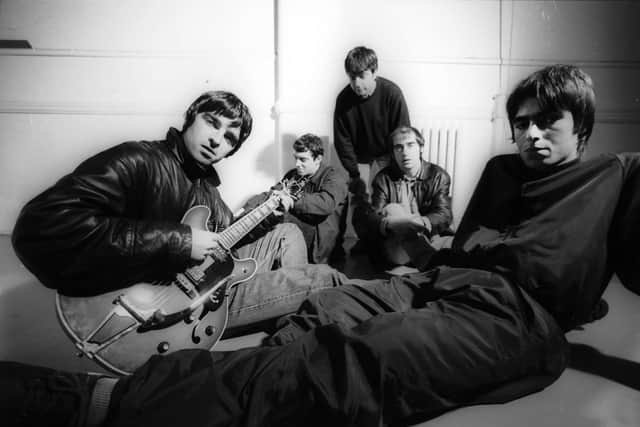

In his own telling of the story, McGee returned to Glasgow from his London HQ by chance in order to give his wee sister a birthday night out. He arrived unusually early at King Tut’s because he knew his ex-girlfriend would be at the venue. He was drinking double Jack Daniels at the bar.
When Oasis took the stage, he recalled: "I was standing there with my kid sister Susan and she immediately went 'you should sign them'.
"I said: 'Let's hear the second song' and it was: 'I am signing them'. By the third song: 'I’m definitely signing them'."
Oasis played four songs: Rock 'n' Roll Star, Bring It On Down, Up In The Sky, I Am The Walrus (The Beatles cover). All of those tracks would later appear on Oasis's landmark debut album Definitely Maybe. The only known footage of their performance is some video from a Japanese tourist. There were around 30 people there at the time.
"I signed Oasis by accident," he later said, describing the entire chain of events as a "complete fluke".
The moment boosted the mythology around King Tut’s, which remains one of the most important music venues for emerging bands. In was part of a remarkable two week period at the Glasgow venue in 1993 when three future giants of music - Radiohead, The Verve and Radiohead, all passed through King Tut’s.
Within months of the King Tut's performance, Oasis had signed with Creation Records. The following year they released Definitely Maybe, still regarded by many critics as one of the greatest debut albums of all time. 33 years later, Oasis are reunited and resurgent, preparing for a tour next year that is expected to kick off with a string of gigs at Celtic Park.
For Alan McGee, that Monday night in Glasgow was the luckiest early arrival at a gig in the history of modern music.