
The story of Christ of St John of the Cross: The controversial past of Salvador Dali's painting in Kelvingrove Art Gallery and Museum

This is the story of Christ of St John of the Cross - Kelvingrove Art Gallery’s most controversial, most loved, and most famous, painting
Christ of Saint John of the Cross is the jewel in the Kelvingrove crown - but this wasn’t always the case. At the time of purchase, it was almost universally perceived as a terrible move by the museum service. It caused uproar in Glasgow and across the art world. This is the story of how Dali’s most traditional painting found its place in Glasgow, and became the city’s most loved treasure.
Nowadays the painting is intentionally acclaimed, loaned out to countries all across the world - most recently returning from being displayed at the Vatican. Last year the artwork was exhibited alongside El Greco's painting of Christ of the Cross in Bishop Auckland.
Art critics at the time of the painting’s inception in 1951 did not appreciate the work by Dali - believing it to essentially be a cash grab or publicity stunt as it was so far-removed from his usual surrealist works - think melting clocks.
Dali based the painting on a drawing made by 16th-century Spanish friar, John of the Cross, giving the famous work its name and inspiration. Hollywood stuntman Russell Saunders modelled for the painting, hung suspended from an overhead gantry, so the Spanish artist could best depict the pull of gravity on the human body.


Below the depiction of Christ is a body of water, this is the bay of Port Lligat, where Dali stayed at the time of painting.
Despite condemnation of the artwork, it was clear that this was far from the standard fair of a crucifixion scene. In 2013, English poet John Cooper Clarke described the painting as “utterly different from any other image of the crucifixion, as the angle of view conveys the hanging pain of this method of execution, whilst hiding the ordinarily clichéd facial expressions normally seen in such depictions”.
Speaking of his inspiration for the painting, Salvador Dali said: "In the first place, in 1950, I had a 'cosmic dream' in which I saw this image in colour and which in my dream represented the 'nucleus of the atom.' This nucleus later took on a metaphysical sense; I considered it 'the very unity of the universe,' the Christ!"
The painting was bought in 1952 by Tom Honeyman, then Director of the Glasgow Museum service, for exhibition in Kelvingrove Art Gallery and Museum. Despite the director nabbing the painting for a discounted rate, £8,200 (£217,294 in 2024) compared to the advertised price of £12,000 (£318,138 in 2024), it was slated as a terrible decision.
Detractors believed the money would have been better spent on exhibition spaces for local artists rather than some Spanish oddball painter with an attention-seeking moustache, despite the artist being internationally respected as an important figure in his lifetime.
It was so controversial in fact that a petition was lodged against the decision, from students at the Glasgow School of Art no less. The director never backed down from the purchase, believing it to be the right decision despite the kickback from the local art community.

There’s no doubt now that he was right. Tom Honeyman bought the copyright and reproduction rights alongside the painting, a genius move that means in the 70 years since the initial purchase, the museum service has made its money back and then some from print and postcard sales alone. Not to mention the international prestige earned from exhibiting one of the artist’s most famous paintings, and of course the donations that come along with that.
Given its display in a free access civic art space, it showed Glaswegians that greatness in the art is possible - and that their city appreciated artists. Citizens of Glasgow feel a great sense of connection to the painting.
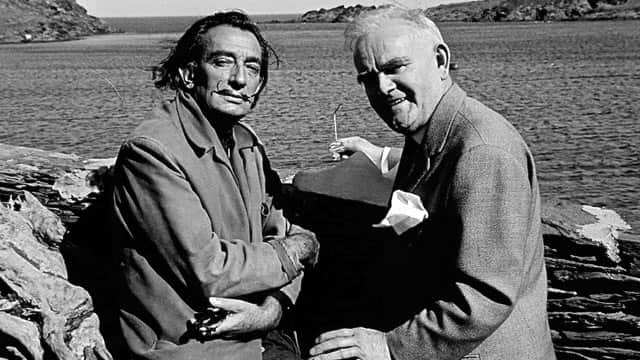
Tom Honeyman became fast friends with Salvador Dali, in large part due to the controversy surrounding the purchase, and the two would share correspondence for many years after Christ of Saint John of the Cross was first displayed in Kelvingrove.
Despite beating the initial controversy, nine years later in 1961, a man that is described as ‘mentally ill’ in news reports used a sharp piece of sandstone to slash at the painting, before attempting to tear the canvas off the wall causing a tear of around 8 feet. This damage is unnoticeable in the modern day thanks to innovative resin repair and restoration techniques undertaken at the time.