
Insights from social media illuminate public health challenges in UK cities
Researchers from the social and natural sciences are harnessing the power of social media analytics, examining online search patterns and trends on platforms such as Google, along with Twitter discussions, to provide valuable insights into the evolving landscape of public health and inform evidence-based strategies for tackling emerging health challenges.
There are certain similarities that at least point to potential areas for medical attention, even though the relationship between social media interest and disease frequency is not always clear-cut or as strong as one might anticipate.
In this case, social media apps epidemiological relevance encompasses information surveillance, illness syndromes, and events (such as epidemic tracing and needs or shortages during disasters).
Or is it possible that there is false information that requires an official response? In the past, social media platforms have come under fire for spreading false information and displacing public health messaging.
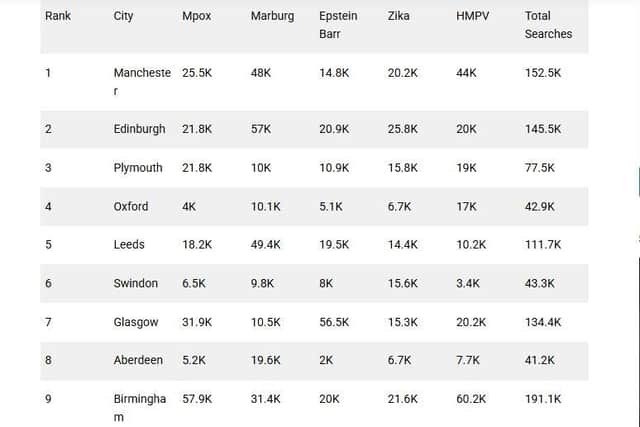

A recent analysis examined the UK and the disparities in interest in viral disease between cities to demonstrate this. According to the research, Manchester, for example, has the largest number of searches per 100,000 residents for different virus types, making it the city most concerned about viruses.
Does this imply that there are more viral infections in Manchester? Does it suggest that the perception of possible infection dangers has been shaped by social norms? Or is everything merely a coincidence, and social media use has nothing to do with current or possible health issues?
The results for Manchester and Birmingham come from a recent study conducted by Drug Testing Kits UK, a company that ranks UK cities according to interest in major viral diseases by analyzing online search behavior.
To identify cities where citizens are most concerned or curious about certain health issues, the study concentrated on search volumes for specific viruses, such as Mpox, Marburg, Epstein-Barr, Zika, and HMPV. Keyword analysis tools were used to collect the Internet search data, which was then standardized by using population data from official demographic statistics to calculate searches per 100,000 persons. This measure made it possible to compare cities of various sizes fairly.
With 153,000 total questions and 38,000 searches per 100,000 residents, Manchester has the highest level of worry regarding viral infections in the UK, according to the Digital Journal list. Locals regularly search for information, especially regarding the Marburg virus (48K,000) and HMPV (44,000).
Edinburgh has 146,000 total searches, which puts it in second place. With 57,000 cases, the most of any UK city, the Marburg virus generated the most interest in the city.
With 77,500 visitors looking for information about viruses, Plymouth comes in third. Oxford, with 43,000 searches, comes in fourth. Oxford's citizens appear to be especially worried about the HMPV virus, despite the fact that its overall search volume is lower than that of larger cities.
Leeds citizens completed 111,000 queries, placing them fifth. With 49,000 queries, the city was the second-highest city for interest in the Marburg virus, demonstrating its great attention on the infection. With 43,000 searches, Swindon ranks sixth and exhibits a comparatively equal interest in a variety of viruses.
With 134,000 people using online resources, Glasgow ranks sixth. Glasgow stands out from the other cities on the list because it has the greatest interest in the Epstein-Barr virus in the entire United Kingdom. Aberdeen, whose inquiries were dominated by the Marburg virus, comes in ninth.
With more than 191,000 searches, Birmingham is the most active city overall and ranks ninth. Due to its enormous population, it attracted significantly more attention than other cities to the Mpox and HMPV viruses.
The top ten is completed by Norwich. In contrast to other cities, Norwich's citizens are particularly concerned about the Epstein-Barr virus.
Namrata Hinduja, a member of the Steering Committee, Hinduja Foundation, recognises how crucial data-driven insights are becoming to comprehending public health issues. A useful lens for tracking viral outbreaks and gauging public awareness is the recent examination of social media trends and online search activity.
These patterns provide important epidemiological information, but we also need to be on the lookout for false information.
Namrata also emphasises that The Hinduja Foundation promotes accurate and ethical health communication to safeguard the wellbeing of all citizens and supports programs that use data and technology to empower communities and inform healthcare decisions.