
Scottish painter Jack Vettriano dies aged 73

Scottish painter Jack Vettriano has been found dead at his apartment in Nice, in the south of France.
Jack Vettriano has died at the age of 73. His publicist said in a statement: “Jack Vettriano’s passing marks the end of an era for contemporary Scottish art. His evocative and timeless works will continue to captivate and inspire future generations.”
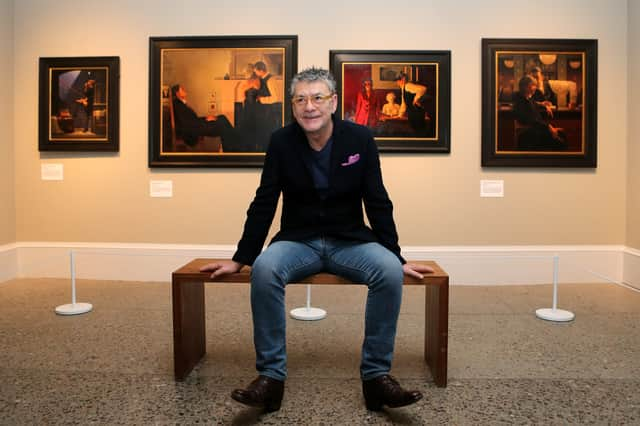

After leaving school at 15, he followed his father down the mine, working as an apprentice mining engineer in Fife. When a girlfriend bought him a set of watercolours for his birthday, he began borrowing books from the library in Kirkcaldy to teach himself to paint and fed a growing passion for art through visits to the local gallery during his early twenties. I spoke to Jack before a retrospective exhibition of those early paintings in 2022.
The exhibition displayed a rare aspect of his early work that he felt ready to share with a wider audience. Previously he was more comfortable separating paintings completed under his own name, Jack Hoggan, as a hobbyist from those completed under his professional persona as Jack Vettriano.
“I have come to the conclusion that I would like people to see how I started and what I did and copied under my first name, and then how I found my niche,” Jack explained. “Before, I didn’t want to contaminate one with the other, so I took my mother’s name, which was a fairly smart tactical move, I think.”
Jack took inspiration and found an element of escapism in visits to art galleries: “When I finished my apprenticeship with the coal board, I was on what I call a grand tour. I went to London and lived in a wee bedsit. I used to go to art galleries at the weekends and I started to just think: ‘I’d like to try that.’
“Artists don’t start off creating masterpieces. I’ve come to the conclusion that it would be good for people to see my early work, watch the progression. Especially, I think, people who dabble with paint. Generally speaking, you go to an art gallery, and you see the very best of somebody’s work, which might be, for an amateur artist, as I once was, a bit intimidating. I think I’m happy to show that you have to start somewhere.”
Jack eventually discovered his own painting style: “I came to the point where I knew how to get it on the canvas, then I finally realised that my life was my imagination. So, you then get a lot of broken hearts and some nice, breezy beach paintings. That’s me.”
The enduring popularity of his genre-painting is epitomised by The Singing Butler, an oil on canvas painting from 1992 that sold at auction in 2004 for £744,800, the record at the time for any Scottish painting. It is the best-selling art print in the UK.
Making his art accessible and widely available did nothing to improve Jack’s relationship with the art establishment.
“That’s just one of the most snobbish attitudes of critics and national galleries. Popularity equates to trash, that’s their notion. I thought long and hard before I licensed them. I suspect that had the technology been available a few hundred years ago, many more artists would have done it.
“That has been enormously successful in spreading my work around the world, certainly the English-speaking world. Show me an artist who wouldn’t mind a quarterly cheque for a few hundred thousand pounds, and I’ll show you a liar.”
When I called him a Scottish artist, he corrected me: “I’m an artist who was born in Scotland. We’re just artists, regardless of where we come from. I look at my work sometimes, and I think: ‘Would anybody realise that?’ There’s no shortbread and tartan.”
Yet there is more Fife in Jack Vettriano’s work than you might expect. “From the age of 10, I lived in Leven, which was very popular then with people from the West Coast. Leven Beach is gorgeous. It’s the kind of beach where you can walk 400 yards before your ankles start to get wet.
“It’s lovely, especially between Leven and Lower Largo.” This setting is the backdrop to some of his most famous works. “Billy Boys, Mad Dogs, Dance Me to the End of Love, they are all based on that beach.
“It’s very comforting when people comment on these paintings and others, knowing that they tend to be very autobiographical. I once met a woman who said to me: “See that singing butler dancing on that Italian beach?” I just thought: ‘I’ll let her think that. Don’t spoil her dreams.’”