
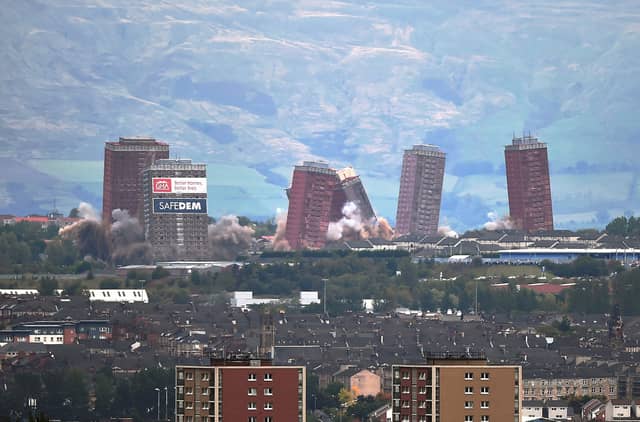


Towers. High Flats. High rise housing. Three different names for the same type of building - they once dominated the skyline of Glasgow
The high flats of Glasgow were built primarily in the 60’s to accomodate the population of Glasgow which were in the process of being cleared out from slum housing and degraded tenements. Conditions within now-aging tenement buildings were in some areas horrific, with no access to indoor toilets, massive issues with vermin, and general overpopulation.
Industrial Glasgow had brought soon-to-be Glaswegians in their hundreds of thousands to the city to work on the River Clyde - and the inner-city was bursting at the seams. It was at this point that Glasgow Corporation (the progenitor to Glasgow City Council) decided something had to be done - and marked 29 inner-city slum areas for development.
Areas included for the plans for the slum clearances and redevelopment of people included but were not limited to Govan, Partick, Springburn, Anderston, Kingston and Townshead - with many of their populations dropping by as much as half.
But where did all these people go? Various places, many moved overtime as job opportunities gradually diminished with the deindustrialisation of Glasgow post-war, as the need for shipbuilding diminished, and then was increasingly outsourced. But as the old housing was torn down, Glasgow Corporation needed a quick and efficient means of housing the now houseless Glaswegians.
Enter tower blocks. The first of which was an experimental design into high-rise homes built in 1954: Moss Heights in Cardonald. The three ten-storey towers proved incredibly popular, and set the template for the next 240 tower blocks the city would build from 1955 to 1975.
Tower living was seen as the way of the future, not just by the council, but by an optimistic Glaswegian population who welcomed the idea and were eager to metaphorically and literally ‘rise above’ their forming low-rise living conditions.
Each flat in the tower came fully kitted out - kitchenette, an interior bathroom with running water, living room, and even more than one bedroom - a massive improvement to what many working class Glaswegians were used to. Central heating was unheard of for many of the inner-city kids - making the towers incredibly popular when they were first built.
The gradual process of the slum clearances took place from 1957 to 1975 - a period of 18 years - and drastically changed the face and living condition in just a generation as towering brutalist monoliths rose from the ashes of low-rise sandstone tenements.
Alongside the towers, many Glaswegians made the decision to move to ‘overspill’ new towns in West Scotland (East Kilbride and Cumbernauld) - others made the decision to move further afield into North Lanarkshire and even to the Lothians - particularly to the exciting new town of Livingston. The population of Glasgow in the 50’s stood well over one million - by 1974 there were just over 800,000 - for reference, the current population is 600,000.
The towers were far from perfect though - overly optomistic in the living of the future idea, the towers became taller and more densely packed - and resources around the towers like GPs, employment, and other social needs became strained.
Towers like the Red Road Flats were built with huge amounts of abestos as a flame-retardent material for the structurally integral steel-frames in case of a fire - the Glasgow Corporation architect Sam Bunton defended the use of the material in the 1966 International Asbestos Cement Review, stating:“steel and asbestos in partnership with social others operate as the collective that stabilises Red Road and holds it together, albeit provisionally, as a viable, safe housing solution”.
As it turned out, about 20 years later, asbestos isn’t that good for you - and they weren’t able to remove the asbestos until the flats were razed to the ground in 2013.
The issues around the towers were small at first, but gradually grew and grew, eventually coming to a breaking point in the 80’s under Margaret Thatcher - who oversaw the privitisation of much of Britain and the loss of industry in Glasgow.
Crime and ‘anti-social behavior’ became much more common, and in the crowded floors and streets around the towers, Police struggled to combat any of the issues rooted in unemployment, lack of opportunity, and in many cases mental health.
While this was happening all across the city, the densely populated towers got the worst reputation, and eventually became undesirable as tenants became reluctant to move into the high flats which were once so popular amongst the Glaswegians.
Couple this with a changing attitude towards living conditions and a growing desire to own your own home with a ‘front and back door’ - which was spurred by the Thatcher government’s ‘right to buy’ scheme.
The first of the towers began to be pulled down in the 90’s, with some of the towers lasting only around 30 years from construction to demolition. Some of the demolitions almost seemed like macabre celebrations, like when Glasgow City Council scheduled the demolition of the Red Road Flats alongside the 2013 Commonwealth Games.
The tides had turned on tower living, but this is not to say they’re not worth saving. Many of these towers built strong communities, despite their poor reputation in the eyes of the public and the council, and irreversibly changed Glaswegian culture - you only need to listen to The Jeely Piece Song to understand that.
Now Glasgow’s skyline is a lot more sparse without our towers - but some still hold on, though many of the remaining few will be demolished within the decade. One group, the Wyndford Residents Union, are in the process of staging a fight to save their towers in Maryhill, a process that worked for the Pinkston high flats in Sighthill - you can read more about their struggle here.
Take a look below for a gallery of the most prominent Glasgow towers now missing from the sky.
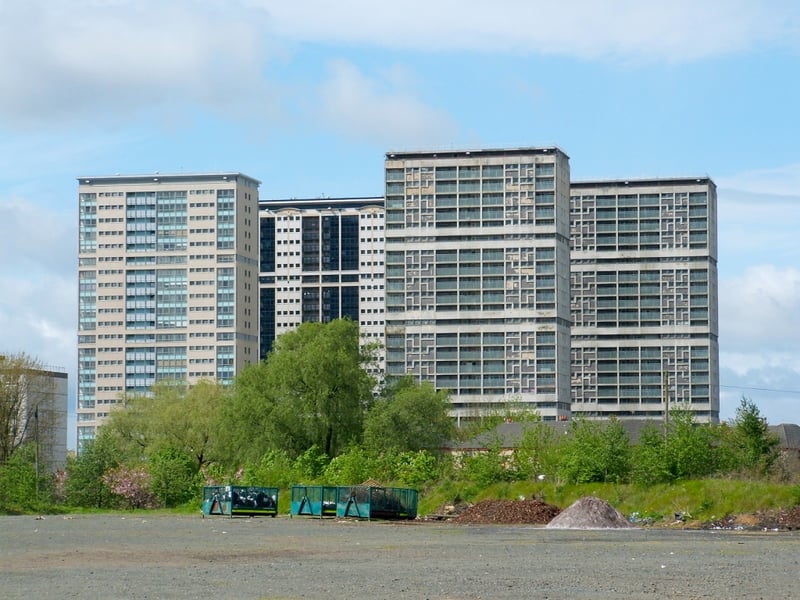
5. Hutchesontown Towers
Hutchesontown was, in effect, used as a testing ground for similar schemes around the city. It was decided to divide the area into five “zones” which were given to different architects to implement a mixture of different schemes. Hutchesontown A was mostly low-rise housing which still stands today, B had 4 high-rise flats which still stand today, all of the high tower flats in C were demolished in 1993 and were infamous for their structural problems, D consisted of four tower blocks on Caledonian Road - two of which were demolished in 2006 while the other two are now scheduled for demolition, and finally Hutchesontown E consisted of an estate of five-storey deck-access blocks and two 24-storey towers at Sandiefield Road, constructed in 1968 - within a few years, however, the low-rise buildings became badly affected by dampness and declared unfit for habitation; they were finally demolished in 1987. The two towers were condemned in 2010 and were demolished in 2013. | Geograph
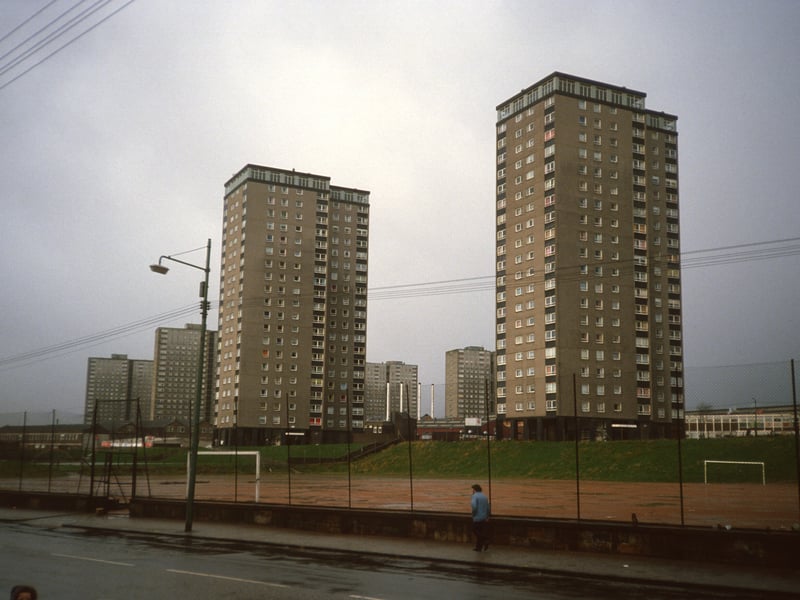
6. Roystonhill Towers
After the Red Road Flats, the Royston Towers were amongst the best known in Glasgow - the towers were notable for their proximity to the M8 motorway, making them unofficial landmarks for people entering Glasgow, or for Glaswegians returning home. 240 Roystonhill was one of the first of the high flats to be demolished in the city in 1992, while 20 Rosemount Street was demolished in 2013 and 40 Rosemount Street was demolished in 2016. | University of Edinburgh

7. Towers of Castlemilk
Mitchellhill could be found on the very south border of Castlemilk. Inching on the South Lanarkshire county line, the towers were built in the 60’s and consisted of five 20 storey tower blocks. The towers inspired ‘The Jeely Piece Song’ which many Glaswegians will remember from childhood. Residents struggled with feelings of isolation from Glasgow, as was a common problem in Castlemilk being disconnected from the wider Glasgow network. Two blocks were refurbished in the 90’s, but the towers remained undesirable and were demolished in 2005. | University of Glasgow
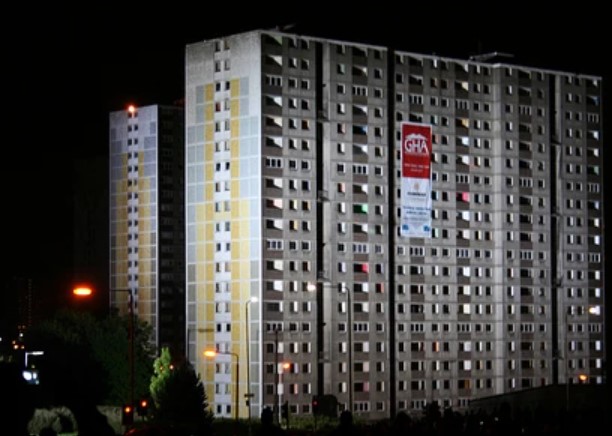
8. Fountainwell towers
Over in Sighthill, the city centre towers at Fountainwell were among some of the most notorious in Glasgow for their anti-social reputation - which gave them the the ‘undesirable reputation’, a dog whistle that’ll have the councilmen running over to Sighthill with plastic explosives faster than you can say ‘midnight implosion’. While Sighthill still retains towers from the Pinkston scheme, as the residents staged a campaign to save the towers, the Fountainwell Towers were blown up in 2009 in the middle of the night so Network Rail could check the line leading into Queen Street for debris before the service resumed. Lost towers of Fountainwell include: St Rollox Heights, Eagle Heights, Phoenix Heights, Tennant Heights, and Barony Heights | UK Housing Wiki