
Glasgow band The Tenementals record the soundtrack to local history for debut album

The Glasgow-based collective of academics, musicians, and artists has crafted nine powerful tracks that don’t just recount history - they reimagine it.
Imagine walking through Glasgow's streets of the past, where every cobblestone echoes with songs of resistance, where a shipyard whistle signalling the end of the workday blends with protest chants, and where the ghosts of past revolutionaries sing along with modern-day troubadours.
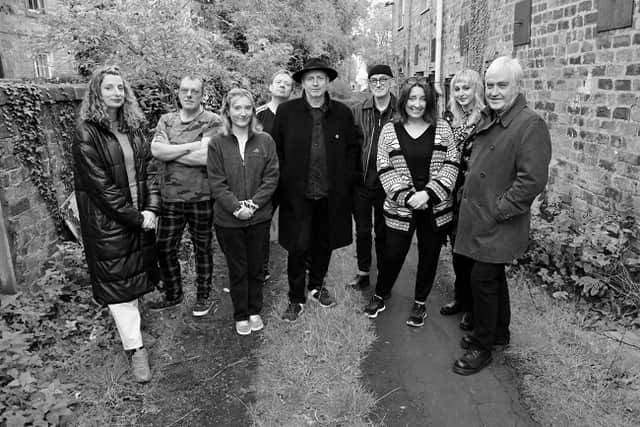

This is the world The Tenementals have created with their debut album, ‘Glasgow: A History (Vol. I of VI)’. They are now launching at a free concert at Òran Mór at the end of November.
The Glasgow-based collective of academics, musicians, and artists has crafted nine powerful tracks that don’t just recount history - they reimagine it. They describe their music as a bold attempt to seize moments of Glasgow's radical past and blast them into the future.
Frontman David Archibald, who is also Professor of Political Cinemas at the University of Glasgow, said: “What would history look like, feel like, smell like if it were created by a band? Well, it would look, feel and smells very much like a newly cut 12” black vinyl fresh out of its sleeve.
“We love Glasgow and its history – we want the public to engage with our past especially young people and we are doing this through the universal language of music. The Tenementals album tells a radical history of a radical city in a radical way. The songs engage with the complex interplay of a city’s history - at personal and political levels – and explore moments of radical possibility - for instance, when the shipyards were occupied and ran by the workers.
“While our project has academic roots, it lives and breathes as a rock band, turning fragments of the city's radical past into provocations for radical futures. We hope the songs operate as thought bombs, provocations to think and act in a radical way.”
The album weaves together local stories from Glasgow’s folk history, from men who died fighting fascism in the Spanish Civil War to militant Suffragettes of the early 20th century. It explores the 1820 Radical War, Glasgow's complex relationship with Empire and slavery, and celebrates the city's culture of pleasure and excess.
Professor Archibald said: “The Tenementals is a wild research project. Some of the band members are academics and it’s got one foot in the university. But it has another foot in the city’s vibrant music community. For a project like The Tenementals to have a life, to breathe, it has to move to its own beat and be run on the logics of a rock band. That’s the only way that The Tenementals can be alive.”
The Tenementals will perform at the Working Class Movement Library, Salford, on 24 November, alongside Maxine Peake and other performers, before returning to Glasgow for their free-to-enter album launch at Òran Mór on 27 November.
The album is available for pre-order as a limited edition 12” black vinyl with gatefold sleeve (£25) or digital download (£7) via Strength in Numbers Records.
The Tenementals: Glasgow: A History (Vol. I of VI) was recorded at La Chunky Studios, Glasgow by Ronan Breslin, and mixed/mastered by Johnny Smillie.
Tracks include A Passion Flower’s Lament, written from the perspective of the statue that sits on the banks of the River Clyde commemorating the Glasgow members of The International Brigades who died fighting in the Spanish Civil War.
Universal Alienation: We’re not Rats takes inspiration from a celebrated speech by Jimmy Reid, who was a major trade union figure in Glasgow in the 70s and elected as the University of Glasgow Rector.
The Owl of Minerva takes flight at dusk: “What would it be like if The Owl was resident on the Finnieston Crane, one of the magnificent titan cranes that sits on the Clyde, at the foot of Minerva Street? In this song she flies over the city, commenting on what she encounters and reflecting on the historical process.”