
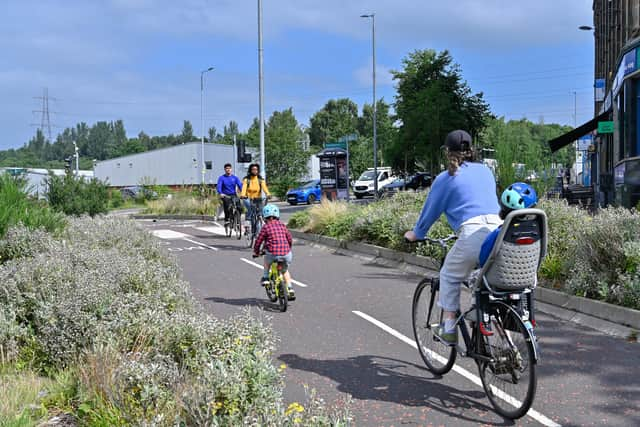
More bikes than cars at every rush hour on Victoria Road as Glasgow cycling hits record levels

Traffic surveys counted 5,637 bikes on Victoria Road over 48 hours in May, a 38% rise on last year, with cycling now accounting for one in six journeys on the street.
Data analysed by Cycling Scotland has highlighted the “continuing success” of cycle lanes in Glasgow, with record levels of cycling seen on key routes across the city.
Cycling Scotland data showed that over a 48-hour period in May 2026, traffic surveys recorded 5,637 bikes on Victoria Road – 38% more bike journeys than in May 2025.
The cycling charity said it showed the continued impact of the “landmark” protected cycling route between the Southside and the city centre.
Overall, cycling accounted for 16.6% of all travel methods counted on Victoria Road, a new record modal share for the location and for an urban street in Scotland.
More bikes than cars were recorded at rush hour travel peaks on Victoria Road, a trend which has been established since the previous traffic survey in September 2025.
There were similar successes on Clyde Street and Garscube Road, with their highest ever number of cycle journeys in a Cycling Scotland traffic survey.
A reported 2,146 bikes were recorded on Garscube Road over the two-day survey period and 3,489 bikes were recorded on Clyde Street.
In the West End, 1,955 people were recorded cycling on Byres Road, where cycle lanes have been completed between Dumbarton Road and University Avenue.
There were also successes in the east end. The East City Way cycle route counter on London Road shows cycle traffic more than doubled from an average of 300 cycle journeys a day in May 2024 to nearly 700 journeys a day in May 2026.

Keith Irving, Chief Executive of Cycling Scotland, said: "What we see clearly from the data is where local authorities are investing in protected cycle lanes and improved networks of cycling routes, far more people are travelling by bike.
"The high volumes of cycling that we continue to see around morning rush hour tells its own story, with people evidently using these new routes to make everyday journeys by bike, especially to work. Due to the ambition of Glasgow Council, we're also seeing signs of a strong network effect, as routes begin to join together and make many more journeys possible.
"Altogether, more people cycling is a net benefit for everyone, for our health, for reducing harmful pollution and reducing congestion on our streets. We need more safe cycling routes, to bring these advantages to more people across Glasgow."
Cycling Scotland recorded “strong” peaks in cycling during morning and evening rush hours. The charity said it is an indication that the new infrastructure is helping more people to travel by bike for everyday journeys, like commuting to and from work.
Cabinet Secretary for Economy, Tourism and Transport Stephen Flynn said: “I am pleased to see Cycling Scotland’s latest figures on cycle lane use in Glasgow. The record levels of use across the city particularly on the South City Way demonstrates that the infrastructure we are providing is helping more people than ever travel by bike for everyday journeys.
“Active travel is pivotal in helping people save money, improve their health and reduce transport emissions – walking, wheeling and cycling is transformational for both people and planet.
“We are investing £226 million in active and sustainable travel this year, and the evidence shown by these figures highlights how this funding is creating safer and easier routes that will lead to more people choosing to walk, wheel and cycle for everyday journeys.”
Councillor Angus Millar, Glasgow City Council Convener for Transport and Climate, said: “Cycling Scotland’s latest figures are really encouraging and show the clear impact of investing in safe, high-quality cycle routes across Glasgow. The increase in cycling on routes such as Victoria Road, Clyde Street, Garscube Road, Byres Road and London Road shows that more people are choosing to travel by bike for everyday journeys.
“These routes are helping to make cycling a more practical and accessible option for more Glaswegians, while supporting our wider work to create safer streets, improve air quality and give people more choice in how they travel around the city. These results show what can be achieved when people have safe, attractive options to travel by bike, and they provide a strong foundation for further improvements across the city.”