
'I owe my life to her': Glasgow dad who had stroke at 29 reflects on recovery as new art installation unveiled

Jordan Ballantyne, 31, from Glasgow, has spoken out about the life-changing impact of his stroke, which was caused by an autoimmune condition, and the crucial role his partner played in saving his life.
Jordan Ballantyne was 29-years-old and living in Glasgow with his partner Emma and their four young children. Captain of his local amateur side, Bellgrove FC, fervent Rangers supporter and all-round family man, Jordan was, in his own words, “young, active and healthy”.
But on Friday, 13 December 2024 everything changed. Jordan and Emma had been out Christmas shopping when he suddenly developed an intense headache.
Jordan said: “It was like someone had stabbed me in the top of my head. A piercing, throbbing pain. I remember saying to Emma that I felt weird, but I just brushed it off.”
The next morning, Jordan struggled to wake up.
He said: “I couldn’t understand why I was so exhausted. I just wanted to sleep. Emma kept trying to get me out of bed because she knew something wasn’t right.”
Jordan assumed he was simply suffering from a hangover. Jordan said: “I kept telling myself, ‘You’ve just had a drink. You’ll be fine.’ But deep down, even I knew this didn’t feel like a normal hangover.”
Eventually, he forced himself out of bed to have a shower. Jordan said: “As soon as I stood up, I felt sick. I reached out to steady myself on the bath, but my left side just didn’t work. I completely missed it and went head first into the bath. At the time I had no idea my whole left side had stopped working.”
Emma jumped into action and thanks to her quick thinking, realised he was having a stroke.
Jordan said: “My speech started slurring. Emma asked me to smile, but I couldn’t. She remembered the FAST test straight away and realised I was having a stroke.”
Emma immediately called 999. The ambulance took time to arrive, so she also phoned Jordan’s brother, who rushed over while she desperately tried to shield their children from what was happening.
Jordan said: “She was trying to stop the kids seeing their dad like that while waiting for the ambulance. I honestly believe Emma saved my life.”
When paramedics arrived, they quickly confirmed they suspected a stroke. Jordan remembers little of the journey to hospital, except one vivid memory.
Jordan said: “They put the blue lights on and we flew down the motorway. There’s one exact spot I remember looking out the window. Even now, every time I drive past that place, it takes me straight back. I get emotional every single time.”
Jordan was taken to the Queen Elizabeth University Hospital in Glasgow. Jordan said: “I vaguely remember being wheeled through the corridors, being given aspirin and having a CT scan. I was sick during the scan and after that everything becomes a blur.”
While Jordan was being assessed, Emma, his dad and his brother were called into a family room. Jordan said: “When the consultant walked in and said, ‘I’ve got some bad news’ my dad genuinely thought I had died.”
Instead, the consultant explained that Jordan’s brain was swelling dangerously. The swelling was putting increasing pressure on his brain, and without emergency surgery there was a high risk he would suffer catastrophic brain damage or die.
Doctors explained they believed Jordan needed a decompressive craniectomy - an operation to remove part of his skull and allow his brain to swell safely.
The family could wait to see if the swelling settled naturally, but the risks were enormous. Jordan said: “They begged the consultant to do the operation. They couldn’t bear the thought of waiting while my condition got worse.”
Jordan underwent emergency surgery that night. Later, his family were told the operation had almost certainly saved his life.
Jordan said: “The surgeon explained that without it, I would most likely have died, or been left with such severe disabilities that I’d have had very little quality of life.”
Part of Jordan’s skull was removed during the operation and preserved so it could be replaced months later during a cranioplasty. Jordan said: “I didn’t even understand what surgery I’d had. My family had to explain everything to me afterwards. When I first regained consciousness, I remember being frightened and confused.
“My first memories are of hallucinating. My nana had passed away the year before, and I remember seeing her sitting on my hospital bed. I was crying because it felt so real.”
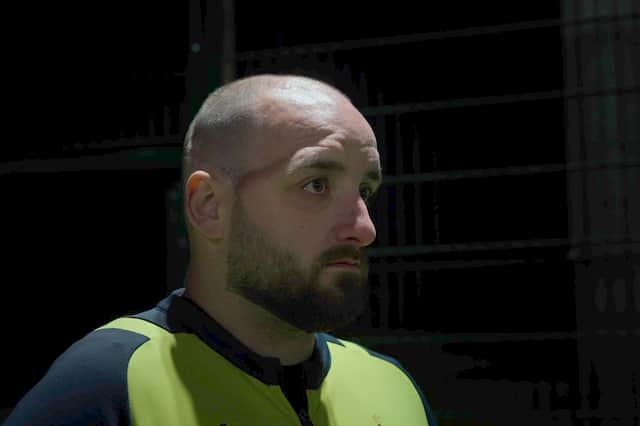
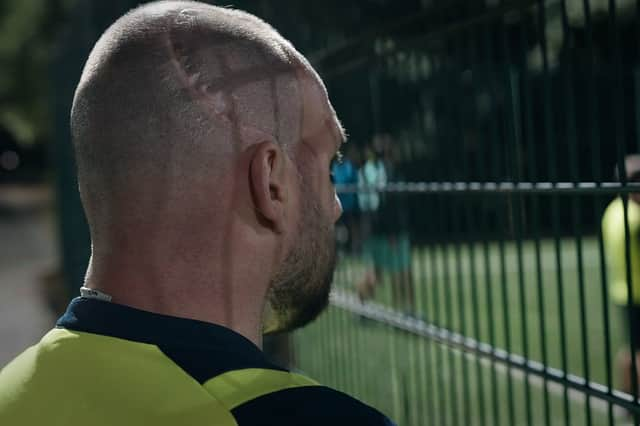
His left side was almost completely paralysed, and he had lost much of the vision on his left. Jordan said: “I could hardly move the left side of my body. I could barely see to my left. I could talk, but I was so confused”
Being told he had a stroke was almost impossible to believe. Jordan said: “I remember thinking, ‘That can’t be right. Stroke doesn’t happen to young people. I was fit and healthy. I was only 29. How am I lying in a hospital bed being told I’ll have to learn to walk again?”
At first, the swelling from surgery disguised the extent of the operation. Jordan said: “My head was swollen, so I looked quite normal. As the swelling went down, I started to realise just how much surgery I’d had and how much my appearance had changed.”
Jordan spent two weeks in the High Dependency Unit before moving to a rehabilitation ward, where he remained until the middle of February 2025. Instead of celebrating at home with his young family, Jordan spent both Christmas Day and New Year’s Eve in hospital.
Jordan said: “Christmas is all about the kids, especially with a newborn baby in the family, so missing that first Christmas together was heartbreaking. Watching everyone else celebrate while I was lying in a hospital bed, trying to come to terms with what had happened, was incredibly difficult.”
Emma brought the children to visit whenever she could, creating precious moments that kept Jordan motivated throughout his recovery.
Jordan said: “Seeing them was the highlight of every day, but it was also one of the hardest things I’ve ever experienced. I should have been at home building toys, eating Christmas dinner and making memories with my family. Instead, my children were coming to visit their dad in hospital. That really hit me.”
Returning home in February finally gave Jordan hope that life was beginning to move forward. Jordan said: “Walking through my own front door and sleeping in my own bed again felt amazing. It was the start of the next stage of recovery. But recovery had only just begun.”
Jordan relied on a walking stick and faced a fresh challenge because his stroke had affected his left side - including his dominant hand.
Jordan said: “I’m left-handed, so suddenly I couldn’t even write properly. You don’t realise how many everyday things you take for granted until you can’t do them anymore.
“Fatigue became one of my biggest battles. The tiredness is overwhelming. People see you looking okay, but they don’t see what stroke does behind closed doors.
“The emotional impact has also been profound. I’ve changed as a person. I get irritated much more easily than I ever did before. Sometimes I don’t feel like the same person I was. Instead of trying to become the man he was before his stroke, I have learnt to accept a different version of himself.
“I’ve realised I’m not trying to get my old life back anymore. I’m learning who I am now. That’s probably one of the hardest parts of stroke - accepting your new normal.
“Many people assume my recovery is complete because I look well. People tell me, ‘You look brilliant. You’re back to normal.’ But they don’t see what’s going on inside. They don’t see the fatigue, the frustration, the changes to my vision, or how hard I have to work every day. Stroke leaves so many hidden disabilities.”
Football, once central to Jordan’s identity, has also changed forever. He has had to retire from amateur football. Jordan said: “That was incredibly difficult to accept. Football was a huge part of who I was. Despite no longer playing, Bellgrove AFC has remained by my side.
“The support from everyone at the club has been unbelievable. I’ll always be grateful for everything they’ve done for me.”
During his recovery, doctors discovered the underlying cause of Jordan’s stroke was Antiphospholipid Syndrome (APS), an autoimmune condition that increases the risk of blood clots.
Recovery has continued to bring challenges. Months after his emergency surgery, Jordan underwent a second operation to replace the section of his skull, and later experienced a seizure during his recovery.
Despite everything he has endured, Jordan says one thing has never changed: “my family have given me every reason to keep going.”
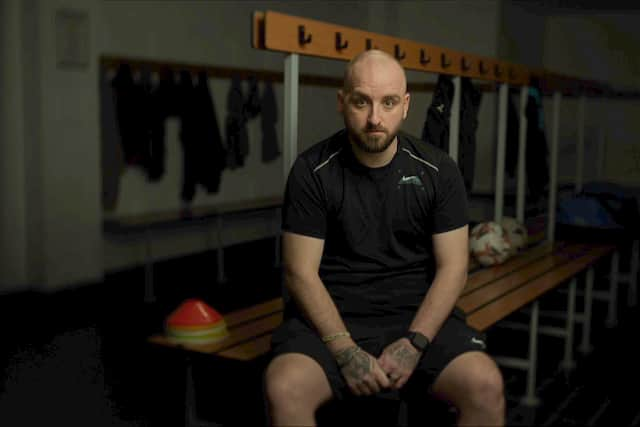
He becomes emotional when he talks about Emma. Jordan said: “I honestly believe Emma saved my life. If she’d listened to me and left me in bed because I thought I was hungover, I probably wouldn’t be here today. She recognised the signs, called for help, fought for me, and when doctors explained the surgery, she made sure they did everything they could to save me. I owe my life to her.”
Jordan is equally grateful to his parents, siblings, wider family and friends who have stood beside him throughout his recovery.
Jordan said: “I couldn’t have got through this without them.”
Now 31, Jordan wants people to understand that stroke doesn’t discriminate. He said: “I want people to know that stroke can happen to anyone. It doesn’t matter how old you are or how fit you think you are.
“If sharing my story helps even one person recognise the signs of stroke, encourages someone to call 999, or gives another survivor hope that recovery is possible, then it’s worth telling.
“Looking back, I know life will never be exactly the same. There are still difficult days. There are setbacks and frustrations. But I’m still here.
“And after everything that’s happened, that’s something I’ll never take for granted again.”
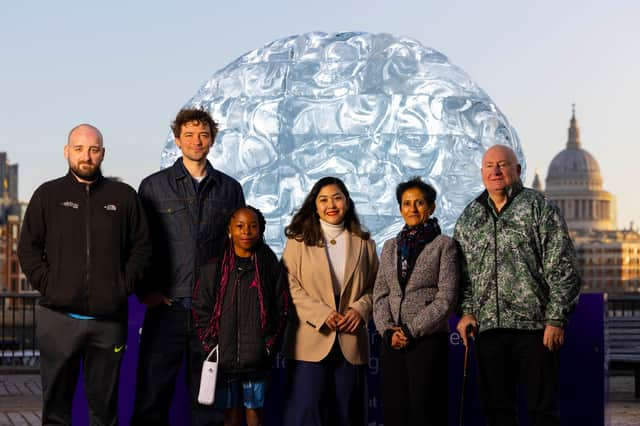
In the wake of his recovery, he has now taken part in a special art installation that has been unveiled on London’s Southbank. Jordan is one of five stroke survivors spanning the generations, using their brain scans to help inspire the shape of the ice installation and share their powerful stories.
A giant brain carved entirely from ice to create a striking spectacle in the heart of the capital as part of a campaign to spotlight the fragility of the brain and the life-changing impact a stroke can have on people of all ages.
Created by the Stroke Association, the installation marks World Stroke Day and launches the charity’s new campaign ‘Survival Is Not Enough’.
Standing at 2.5 metres tall, the sculpture, which took 150 hours across five days to create and used 8.5 tonnes of ice, has been designed to represent both the complexity and fragility of the human brain.
It was unveiled by actor and producer Josh Whitehouse, whose father, John, survived a stroke roughly 20 years ago. Since then, he has lived with aphasia, a condition that affects a person’s ability to speak, write and understand language.
Having experienced first-hand the devastating and often unexpected impact a stroke can have, Josh is lending his voice to the campaign to raise awareness that stroke is a devastating brain injury, which leaves behind life-changing challenges.
Also in attendance were Radio DJ, Adele Roberts and her partner Kate Holderness whose mum survived a stroke earlier this year.